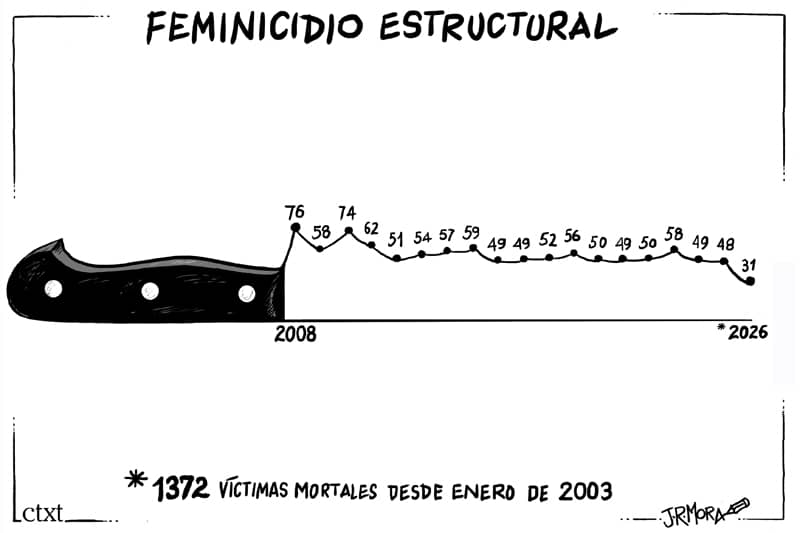
Structural feminicide. Cartoon from 24 July 2026 in CTXT
Three femicides and six orphans as a result of gender-based violence in 24 hours. Three women have been murdered by their partners. The first, aged 29, was killed in Antequera (Málaga), and shortly afterwards another, aged 45, was killed in Alameda de la Sagra (Toledo). Later, in Benahavís (Málaga), the body of a third woman was found in her home, with a stab wound to the neck. According to figures from the Government Delegation against Gender-Based Violence, the death toll from gender-based crimes now stands at 31 so far this year. This figure is higher than the 22 women murdered during the same period in 2025.
These latest cases bring the total number of fatalities to 1,372 since January 2003, the year in which official records began. According to figures from 8 July, there are 108,479 active cases of victims of gender-based violence in Spain recorded in the Comprehensive Monitoring System for Cases of Gender-Based Violence (VioGén).
Data from the Government Delegation for Combating Gender-Based Violence, updated on 21 July 2026
However, according to Feminicidio.net, which maintains a parallel tally to that of the Government Delegation for Combating Gender-Based Violence of all women murdered in Spain, the figure has already reached ten so far this month, compared with the official figure of five, and they have recorded 57 feminicides and other murders of women so far in 2026 in Spain.
According to their figures, since 2010 – the year in which they began documenting femicides in Spain – they have recorded a total of 1,734 cases of women murdered by men.
Figures lend themselves to all sorts of interpretations; so, we can ‘play around’ with them and say that ETA murdered around 853 people over 42 years, and that the number of women murdered by their partners in roughly half that time is almost double that figure, or even more.
There is something perverse about the inevitable lists of figures showing the number of women murdered each year. These lists dehumanise people by reducing them to mere statistical figures, creating an effect that ultimately desensitises us to any related tragedy; perhaps this effect even has a name. But all that changes when one of those murdered women is a neighbour in your neighbourhood, someone you even knew from your village or who lived two blocks away in your town.
It may sound cruel, but I assure you that is not the intention. The geographical and physical proximity of an incident of this kind has a sadly positive impact. I probably won’t remember what I had for dinner a few days ago, but I haven’t forgotten the name of the woman from my local area who was murdered by her partner, nor the circumstances and details of the crime that were reported in the press at the time. And that was 15 years ago.
I think we need something that will put us into that permanent state of lasting remembrance, something that will condition us so that our memories aren’t just a fleeting thought whenever another woman is murdered.
There are more and more laws, more campaigns, protest rallies, more (and better) media coverage and more institutional posturing, but the number of women murdered is not falling and there is little cause for optimism. Perhaps we need to start rethinking our strategy. I wish I had any idea what one of the solutions might be to a structural problem of this magnitude, but I very much fear that we will have to continue tackling it on various fronts. I refuse to believe that there is nothing more that can be done through education to mitigate the devastating effect of this scourge, which threatens to become entrenched as something natural, acceptable and inevitable.