
Whilst many media outlets are already illustrating their articles with AI-generated photographs, fortunately there are no known cases of cartoonists being replaced by generative AI in the traditional or digital press to produce editorial cartoons. Although the case of The Baltimore Sun comes rather close.
We do know of at least one Spanish digital media outlet that has brought in a so-called ‘El Debate’ to produce this rubbish – we’ll talk about that later.
A year after sacking its editorial cartoonist Kevin Kallagher, ‘KAL’ (1955) – for whom he began drawing in 1988 – The Baltimore Sun has filled his slot with images created using generative artificial intelligence.
One such monstrosity provoked quite a few negative reactions from authors and some organisations of cartoonists or those linked to the industry. Although, as pointed out in *The Daily Cartoonist*, this is not the first time they have done so. This is demonstrated in this other piece published on 14 August.
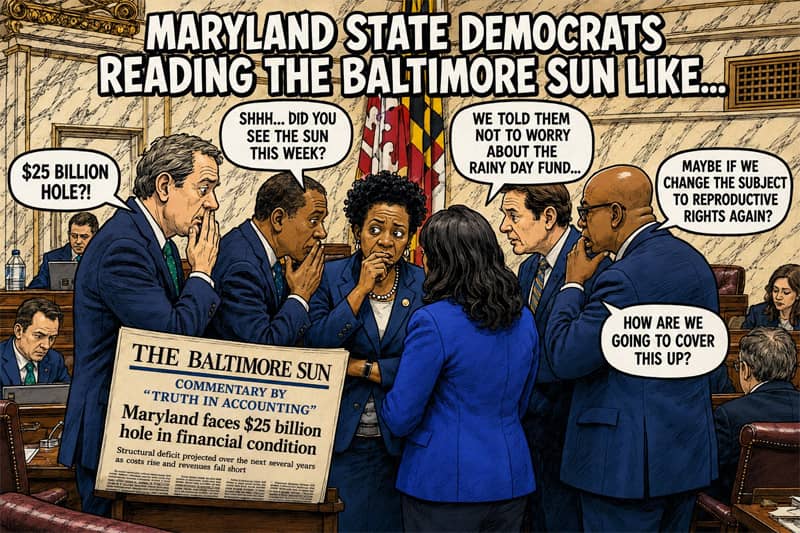
And whilst having a rummage, I found another one dated 25 August. They carried on publishing these things throughout September.
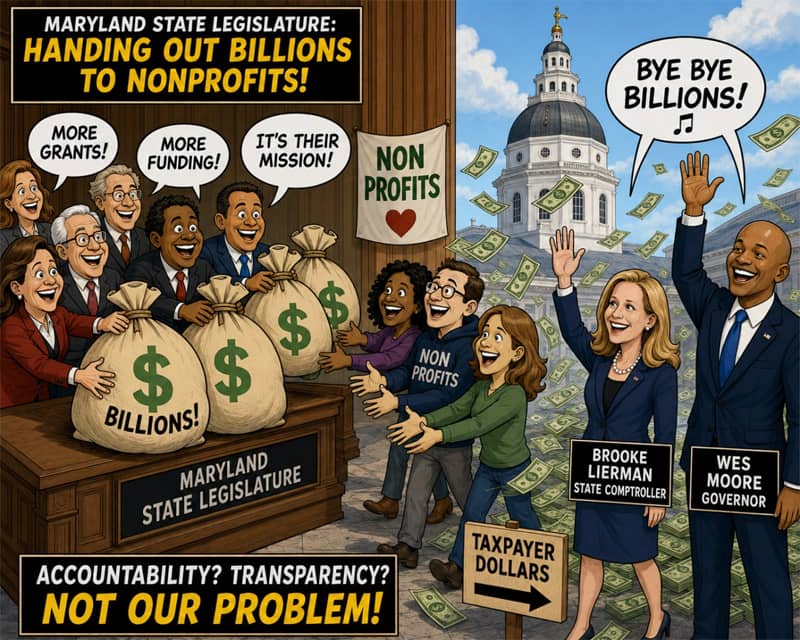
Be that as it may, the image that sparked the debate was one whose style seemed straight out of the illustrations of smiling people in Jehovah’s Witnesses’ leaflets – so typical of generative AI. It’s the typical cluttered scene crammed with text, arrows and little signs that insult any reader’s intelligence by telling them exactly what each element represents. A collection of elements with less soul than a pebble.
There is no twist, nor any humour or satire whatsoever, either in the text or in the image – let alone in the piece as a whole. There is no sign of any intention anywhere. Just little signs and speech bubbles relentlessly fawning over the Mayor of Baltimore, the Democrat Brandon M. Scott.
At first I thought this might be an ironic piece, given that the newspaper is sympathetic to the ideas of the MAGA movement (in January 2024 it was bought by David D. Smith, son of the founder of Sinclair Broadcast Group and a well-known donor to conservative causes and the Republican Party), but this is not the case, as Baltimore has managed to reduce homicides by 68 per cent since 2019, outperforming the national average, and has done so with 400 fewer officers – thereby debunking the myth that increasing police numbers is the only solution to reducing violent crime.
The thing – because I refuse to call it a cartoon – was published in early September and was accompanied by a note stating that this monstrosity had been “created using artificial intelligence tools by the editorial team at The Baltimore Sun”.
Three days later, the American Association of Editorial Cartoonists (AAEC) published an open letter addressed to The Baltimore Sun regarding the newspaper’s use of artificial intelligence in the creation of editorial cartoons and other editorial content. In the letter, amongst other things, this content is described as “rubbish”:
On September 4, 2026, The Sun published what can only technically be called an “illustration” it intended its readers to accept as an editorial cartoon. Whatever the intent, the only message The Sun actually delivered was that it has finally and completely surrendered any remaining claim it may have had to journalistic legitimacy and its former place among the nation’s important newspapers. We are advised this is not their first use of AI for creative content.
The illustration in question was not drawn by an artist or even a human being. It was Artificial Intelligence slop, generated in response to juvenile and uninformed prompts. The result was unsurprisingly uninteresting and an insult to journalism, art, and The Sun’s readers.
The Sun is not alone among American newspapers taking this degrading way out. But it distinguishes itself because for many years it published the work of one of our nation’s premier political cartoonists Kevin Kallaugher (better known as KAL), a two-time Pulitzer Prize finalist and internationally acclaimed artist. KAL was let go by The Sun in what was called a “cost cutting” move. KAL is a long-time member and emeritus of the AAEC.
The AAEC condemns the use of AI for its theft from artists, its misuse of our planet’s resources, and its threat to original, creative thought. The Road to Hell — an America that has outsourced its most important human work — is paved with cost-cutting moves. This slop published by The Sun might as well be a signpost, pointing the way for publications like the Sun to certain irrelevance and then demise.
We urge The Sun to reverse course and take the lead in rejecting the use of AI for editorial cartoons and other creative content for both practical and moral reasons. If so, it can begin to reclaim its place as a leader in American journalism.
Marc Murphy
President
Association of American Editorial CartoonistsBack To News
And three days later, another prestigious organisation joined the chorus of criticism. In an open letter “addressed to the editor and editorial staff of The Baltimore Sun, as well as to any other journalist attempting to pass off images created using generative artificial intelligence as legitimate editorial cartoons”, the Herb Block Foundation joins the American Cartoonists Association in condemning newspapers that use AI to create content. This is the text of their letter:
On September 4, 2026, The Sun published an insipid AI-generated image and tried to pass it off as an actual editorial cartoon. As staunch defenders and promoters of the craft of editorial cartooning, we find this highly offensive and borderline immoral. The illustration, which is nothing more than an ad for local neighborhood businesses and storefronts, certainly does not qualify as satire or opinion journalism.
The Sun is not the only outlet doing this. The Herb Block Foundation condemns this practice across all platforms, especially those claiming to offer journalistic content.
The Baltimore Sun’s poor judgement is compounded by the fact that for decades they had a brilliant award-winning editorial cartoonist working for their opinion pages. Kevin (KAL) Kallaugher, who also draws for The Economist, worked for The Sun until 2025. KAL came up with his ideas for his cartoons without the aid of robots and drew everything by hand. His excellent work was awarded the Herblock Prize in 2015.
This is a textbook example of the threat AI poses to human jobs. AI companies scrape artists' work from the internet without permission, credit, or compensation to train generative models. These corporations make billions at the expense of others.
The great Washington Post editorial cartoonist Herb Block (Herblock) once said that “cartooning is an irreverent form of expression, and one particularly suited to scoffing at the high and the mighty. If the prime role of a free press is to serve as critic of government, cartooning is often the cutting edge of that criticism.” We, the free press, are losing that cutting edge to AI slop.
During the Cold War, Herblock’s ominous character Mr. Atom embodied our collective fears of nuclear annihilation. If Herblock were alive today, one can only imagine the kind of creature he would draw to represent the threat of AI.
Written by Rob Rogers, Board Member
In an article entitled “Baltimore’s most acclaimed cartoonist speaks out against AI-generated images in The Sun”, published in the Baltimore Fishbowl,“KAL” – the former cartoonist for the Baltimore Sun, now working for The Economist – is interviewed and has this to say on the matter:
There’s been a lot of AI-generated content in a lot of different areas. I think what got to me was that you could imagine one person trying it once, but when they started doing it twice, every week or so, it seemed, I thought: this is a pattern.
This is, I think, the first case in American journalism where AI cartoons have basically become part of a publication’s repertoire. That’s clearly instructions from the top; they like this, they’re going with this. And I thought people should know about it. It’s one more of these stories about AI taking people’s jobs. But with something like a cartoon, in the creative realm, it becomes more potent in people’s eyes, because you can see the difference between a cartoon made by a machine and one made by a person, and that a publication is choosing to go with the machine.
Kevin Kallagher, ‘KAL’, joined The Baltimore Sun as an editorial cartoonist in 1988. Although he took a break in 2006, he returned in 2012. He left the newspaper for good in June 2025. You can see some of his cartoons on AI and many others on his Substack.
In Spain there is a somewhat similar case, although it does not involve the replacement of a cartoonist. We find it in "El Debate", that reactionary online pamphlet owned by the Catholic Association of Propagandists, where the great orator, man of letters and former president Mariano Rajoy also publishes his football-related drivel.
There, someone who goes by the name ‘Edwars’ produces daily monstrosities that are utterly uninspired visually (they’re mainly just people saying things), generated using ChatGPT, and who presents themselves as an AI illustrator whith IA.
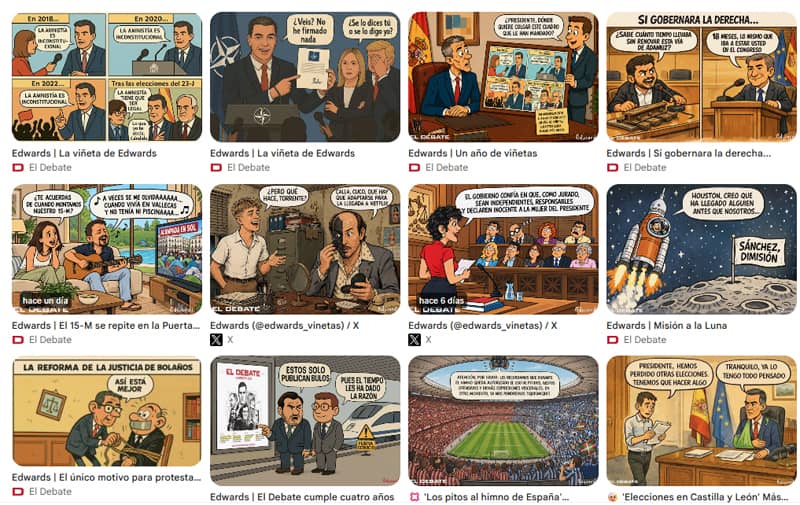
He’s even used AI for his Twitter profile picture so he wouldn’t have to try and draw a 6 and a 4 for his portrait, which leads me to suspect that perhaps there is no one called Edwars and that it is simply a nickname used by whichever hack in the newsroom happens to be on duty that day to draw the ‘cartoon’.
Our Argentine colleague Ricardo Siri, also known as Liniers, had to explain to him back in the day that what he does isn’t actually drawing.

Whilst ten years ago machines were unable to cultivate or replicate a sense of humour, today they’re still a long way off when it comes to creativity.