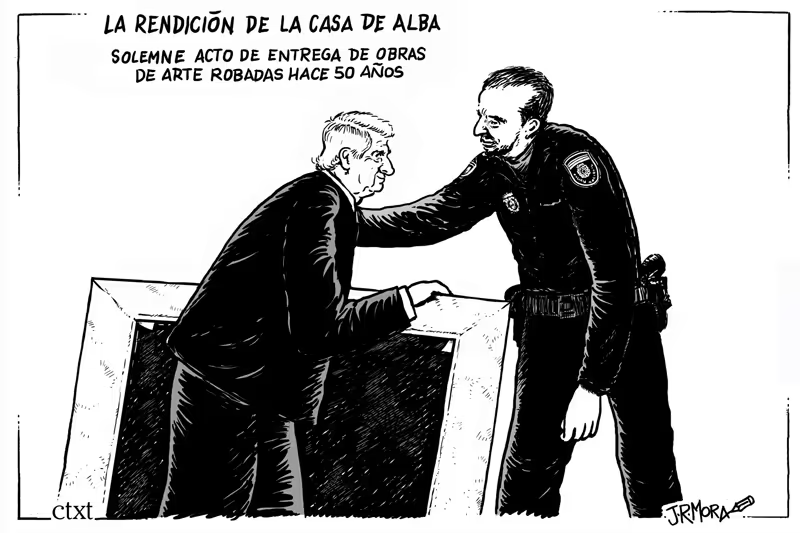
The surrender of the House of Alba. Cartoon of 06/02/2026 in CTXT
Translation of the cartoon: The surrender of the House of Alba. Solemn ceremony for the return of works of art stolen 50 years ago.
You know the one about a Sorolla strolling through Madrid and suddenly he gets lost?
Practically all of Spain's media have been engaged in a new exercise in anti-journalism in the case of the stolen works that "mysteriously" appeared in the Palacio de Liria. Yes, there were more than a few who even headlined that the "mystery" had been solved without quotation marks. No matter where you read it, all you find is the chopped up text of the National Police press release.
The works that appeared were three, a portrait of Isabel de Borbón y Borbón "La Chata" by Joaquín Sorolla and two others by José Moreno Carbonero; a portrait of Alfonso XIII and a portrait of Eduardo Dato.
In X, formerly Tonter, the police told the story with colourful emoticons for those of their readers who have trouble understanding the meaning of the words. One fine morning, Sorolla's painting became aware of itself and, knowing that it had "disappeared", fled from the Palace of the House of Alba and decided to return to Patrimonio Nacional.
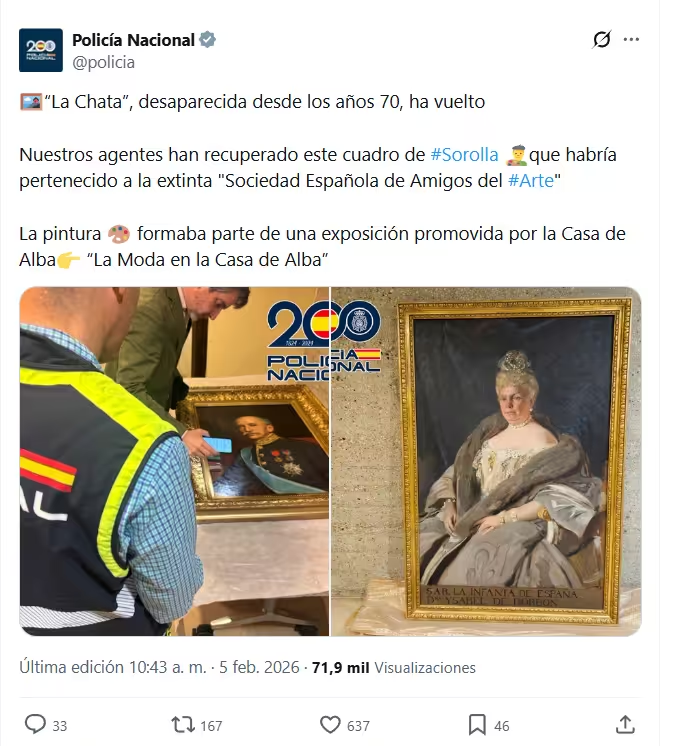
EFE, the public news agency, released an initial headline which was"Sorolla's painting 'La Chata', which disappeared in the 1970s, is located in the Liria palace", then changed to"The House of Alba states that the Sorolla found in Liria is now in the custody of Culture", although the original is preserved in the URL.
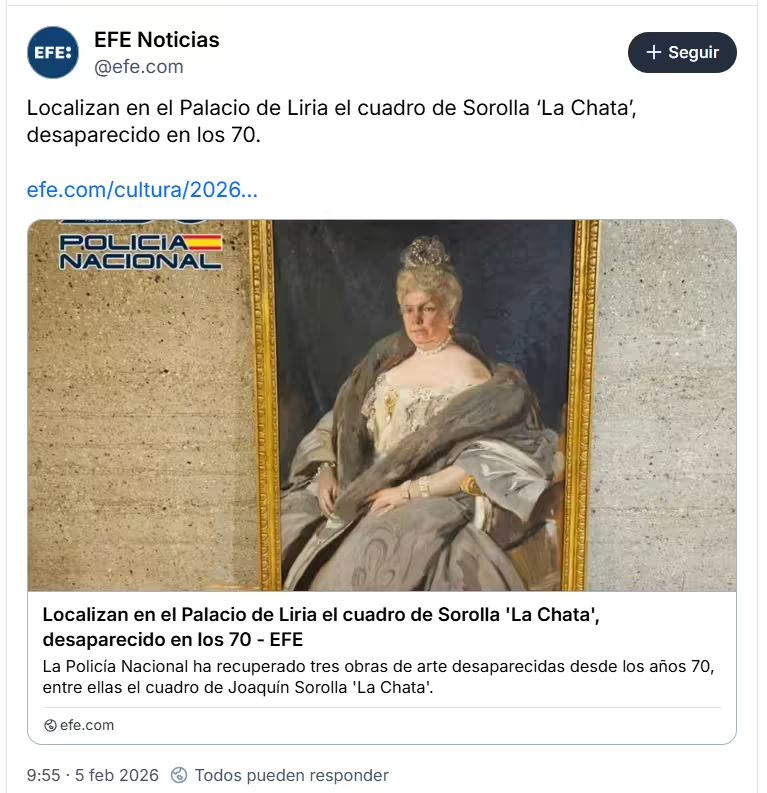
I assume that this change in the headline is because someone from the Casa de Alba sent another note to the media or someone asked them about it. The latter is what anyone would expect from a journalist in a case like this. But no matter how hard I look in the news, not only can I find no statement from the Duke, but there is not even a hint of scepticism or critical thinking. There is no exercise in journalism. In no text do they ask questions, nor do they question in depth (and insistently) those involved, nor do they investigate anything. They limit themselves to a churlish copy and paste of the police press release.
There are many references to the fact that it was "lost" after the dissolution of the Sociedad Española de Amigos del Arte in the early 1980s and that the paintings had been "deposited" in the Palacio de Liria since September 1973.
We also read that in the statutes of this group of art lovers, in article 18, it is stated that after the dissolution of the group, the art objects would become the property of the State, but for whatever reason they failed to hand over some canvases to the appropriate persons. (A complete copy of the original statutes can be found at the bottom of the page).
Article 18. The dissolution of the Company may only be agreed at an Extraordinary General Meeting, expressly convened by an absolute majority of its members, in which case those absent may delegate their vote to another Member, provided that they do so in writing. Once the dissolution has been agreed, the objects of Art and books of the Society shall become the property of the State, and the funds in cash and credits of the Society shall be distributed in thirds to the Prado Museum, the Archaeological Museum and the National Library.
Nor is it at all suspicious that among the prominent members of this society was Luis Martínez de Irujo, father of the current Duke of Alba, Carlos Fitz-James Stuart.
Oh, look! Coincidentally, there are two more stolen paintings here.
It also makes for a few laughs that, once the police had found the Sorolla work, it was the House of Alba itself that confessed to having another two stolen oil paintings. The media sells this as "look at the good people they are and how they collaborate".
In any other operation of this scale, this would have been more than enough reason to seal the palace, search every nook and cranny and confirm that they have not forgotten to confess to having other stolen items, in addition to shining a powerful lamp in the owners' faces to interrogate them and get all the information about how they got hold of the loot.
Instead they distract us with things like the history of what was the headquarters of the Society of Friends in question, a small palace from the late 1600s located in the "Finca de la Moncloa", which was already the Government Presidency complex and was built on the ruins of the building, which had been destroyed during the Civil War and which neither the House of Alba nor the Police know at what point the members of the Society abandoned the palace and decided that the paintings should be "guarded" in the Palace of Liria.
Start committing crimes of receiving stolen works of art and when asked where you got them from, answer with a terse:"I don't know". Then come back and tell me if it worked as well for you as it did for the House of Alba.
Images from the collections of the Biblioteca Nacional de España. CC BY 4.0
STATUTES OF THE SPANISH SOCIETY OF FRIENDS OF ART (1925)
Object of the Company
Article 1.º The aim of the Spanish Society of Friends of Art is to propagate and popularise the appreciation of Art in Spain, and preferably that which is representative of Spanish artistic traditions, either through its own initiatives, or by cooperating with private, collective and State initiatives.
Article 2.º As a means of achieving the proposed purpose, it shall hold exhibitions, award prizes to stimulate artists and shall sit on the commissions to which it is invited by governments. It shall publish an art magazine and shall form and maintain a library of books on artistic matters for the use of its members. It shall admit objects which shall form collections of its property in the form of a museum.
Company Resources
Article 3.º The following shall be the subscriptions of its Members, donations from individuals, subsidies from the State, Provincial Councils and Town Councils; the proceeds from the entrance fees and catalogues of its exhibitions and from the festivals organised for this purpose by the Board of Trustees.
Organisation of the Society
Article 4.º There shall be three categories of Members: Honorary, Supporters and Subscribers. Honorary Members shall be those Spaniards or foreigners, of either sex, whom the Board of Directors considers should be awarded such distinction for services rendered to Art in general, or in cooperation with the aims of the Society. Protectors shall be those who have made donations to the Society for a value of not less than one thousand pesetas or who pay annual subscription fees from two hundred and fifty pesetas upwards, and Subscribers shall be merely those who pay from fifty pesetas up to the amount indicated for Protectors.
The Society shall operate under the Honorary Presidency of H. M. the King (q. D. g.) and the Board of Trustees of H. R. H. the Serene Infanta Doña Isabel Francisca de Borbón, who shall preside by herself or by delegation over the meetings of the Society in plenary session, once a year or as often as H. R. H. H. wishes to do so.
Article 6 The bodies of this Company shall be:
- A) The General Meeting, made up of all the Members in its three categories.
- B) The Board, composed of a President, two Vice-Presidents, a Secretary General, a Vice-Secretary, a Treasurer, a Director of the Journal, a Librarian and twelve Members.
- C) The Board of Trustees, made up of the Honorary Members, the Protectors and those persons who, due to special conditions, are deemed appropriate by the Presidency of the Board of Trustees.
- All these charges will be free of charge.
Article 7.º The General Meeting or Plenary Session shall be responsible for: the approval of the minutes of the previous session; to be informed of the progress of the Society through the Report to be read by the Secretary General; to approve the accounts presented by the Treasurer; to elect or ratify the Board of Directors every five years and to discuss and censure its actions, proposing for the approval of the Board of Trustees whatever it deems appropriate, by an absolute majority vote of those present. Any Member may, if he/she wishes, send written proposals to the Secretary's Office up to two days before the General Meeting, before which they will be read by the Secretary and discussed at the meeting.
The Board of Directors shall be the administrative and representative body of the Company; it shall delegate to one of its members the powers it deems necessary in each case; it shall meet at the request of the majority of its members and as often as called by the President, and shall adopt its resolutions by a majority of the members in attendance. Every five years it shall be renewed or ratified by the Plenary, and it shall be exclusively responsible for filling any vacancies that may occur during the five-year period.
Article 9. The Board of Directors is responsible for: Organising art exhibitions and directing everything that, by virtue of Article 2, should be the object of the Society, as well as administering its funds, giving a detailed account of their investment to the General Meeting at its annual session, or earlier, if expressly required to do so by the Board of Trustees.
Article 10. The President shall represent the Company in all official acts in which it is represented; he/she shall award the prizes referred to in Article 2; appoint Committees, convene Meetings and ensure compliance with these Articles of Association, reporting on his/her actions to the Board of Directors at its first meeting.
Article 11. The Vice Presidents shall stand in for the President in their absence or illness.
Article 12. The Secretary shall be the Head of the office and social premises staff, taking care of the same; he shall draw up the minutes of the Meetings and the Annual Report, to be read at the General Meeting; he shall keep the correspondence; he shall approve the accounts that are presented to the Treasury, acting as the Authorising Officer in all acts arising from the running and development of the Society. He shall report to the Board on the behaviour of the employees, and may dismiss them with the consent of the Chairman.
Article 13 The Vice-Secretary shall replace the Secretary in the event of absence or illness.
Article 14. The Treasurer shall be responsible for paying the accounts which, with the approval of the Secretary, are submitted to him; he shall collect the subsidies, subscriptions and income from the securities forming the capital of the Company, shall carry out the securities purchase and sale operations agreed by the Board, and shall present the accounts and balance sheets for the year for the approval of the General Shareholders' Meeting.
Article 15.º The Librarian shall look after the existing art books and magazines in the Library; he shall propose to the Board of Directors the acquisition of new ones, catalogue them, and when possible, he shall set times for a member to provide them, always on the premises, to the Members for their enjoyment and consultation.
Article 16.º The Editor of the Magazine shall propose to the Board such improvements to the magazine as his good judgement may dictate; he shall seek contributions, and shall ensure that it is published periodically, at least quarterly, and distributed to all Members.
The functions of the Board of Trustees shall be to ensure the prestige of the Society, to cooperate with the actions of the Board and to supervise its management. It shall organise reproductive festivities for the benefit of the Society. It shall study and approve or reject the initiatives of the General, and shall meet whenever its President or the majority of its members deem it necessary. The offices of the Board of Trustees shall be for life and their vacancies shall be filled by the Board itself, and there shall be, in addition to the President and Vice-President, a Secretary.
Article 18. The dissolution of the Company may only be agreed at an Extraordinary General Meeting, expressly convened by an absolute majority of its members, in which case those absent may delegate their vote to another Member, provided that they do so in writing. Once the dissolution has been agreed, the objects of Art and books of the Society shall become the property of the State, and the funds in cash and credits of the Society shall be distributed in thirds to the Prado Museum, the Archaeological Museum and the National Library.
Article 19. The furniture and objects acquired by donation or purchase for the Palacete de la Moncloa, whose patronage is exercised by the Board of Directors of this Society on behalf of the State, shall remain there, as shall all those found in similar cases.
These Statutes were read and approved at the General Meeting of 23 June 1925.
- The President: Duke of Alba.
- The Secretary: Conde de Casal.