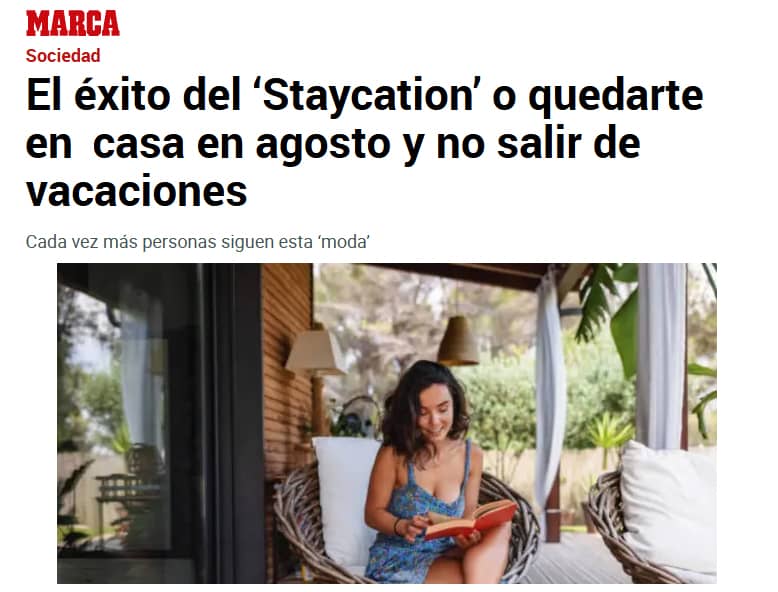
Where are you going on holiday? ‘This year I’m having a “staycation”,’ said nobody, ever. ‘Staycation’ is an English acronym for a holiday at home, formed by combining ‘stay’ with ‘vacation’.
This classic trick used by idiots – which involves claiming that something is a ‘trend’ (putting the word ‘trend’ in inverted commas for added mockery) – is a cheap ploy to attract clicks that is exploited without a second thought.
‘The success of the “staycation” – staying at home in August and not going on holiday’, reads the headline in *Marca*, which adds in the lead: “More and more people are following this ‘trend’”. You couldn’t possibly cram any more nonsense into a couple of lines.
It is not a success, nor has anyone recorded or measured an increase in the number of people who are supposed to use this mutant ‘Gilipollinglish’ neologism in Spain naturally and frequently. Nor has there been any monitoring of usage indicators for those who supposedly associate it with the practice of not going on holiday for the whole of August, either because they’re skint or because they’re posh types with money to spare who travel and relax whenever they please. In both cases, it’s a plea for unbridled capitalism, designed to present poverty in a cool, trendy way.
It’s just as absurd and ridiculous as coming up with a headline claiming that ‘Trabaciones’ are all the rage (a term I often use in spanish to refer to people who work at half-speed or flat out during the holidays, and which I’ve no doubt copied from someone who used it ironically).
Then there is the matter of trying to trace the expression back to some distant origin to lend it historical weight (so that it would no longer be a brand-new, cutting-edge ‘trend’) and attribute it to a supposed original creator. That is when the inventors of non-existent trends come face to face with as many possible realities as there are references.
So, Marca claims that the term was coined in 2005 by *The Washington Post*, supposedly in a survey they carried out or something like that, so they probably came up with ‘staycation’ to use a short, snappy term for a headline that would grab people’s attention.
However, others say that it is rumoured to have been invented by the scriptwriters of the Canadian comedy series ‘Corner Gas’ in an episode broadcast in October 2005.
On Wikipedia, we find that some believe the first reference to this term appeared in a 2003 article by Terry Massey for*The Sun News*, a newspaper in Myrtle Beach, South Carolina
But it seems that the earliest reference to it does not date from the 21st century, because, according to what one reads here, the first historical record may date back to July 1944 in an article in the *Cincinnati Enquirer*, which suggested spending the holidays at home during a period of petrol rationing.
This simply goes to show that such monstrosities do not arise from the mitosis of slang or spontaneously on the streets; in practically 99 per cent of cases, they are coined, disseminated and propagated by the media. Afterwards, certain hacks rework them, embellish them, reinterpret them and mould them to suit their editorial agendas, and the rest is simply a matter of repeating and parroting.