The Australian Cartoonists Association (ACA) has drawn up and published its policy on the use of generative artificial intelligence by its members.
Although this is something that other professional bodies in various countries have already done, they are the first to raise ethical concerns about the impact of AI platforms on the environment and to demand that any member whose work gives rise to doubts must provide reasonable evidence of their creative process and authorship.
Its vice-chairman, David Blumenstein, announced this on his social media accounts, and its mission statement is set out as follows on its website.
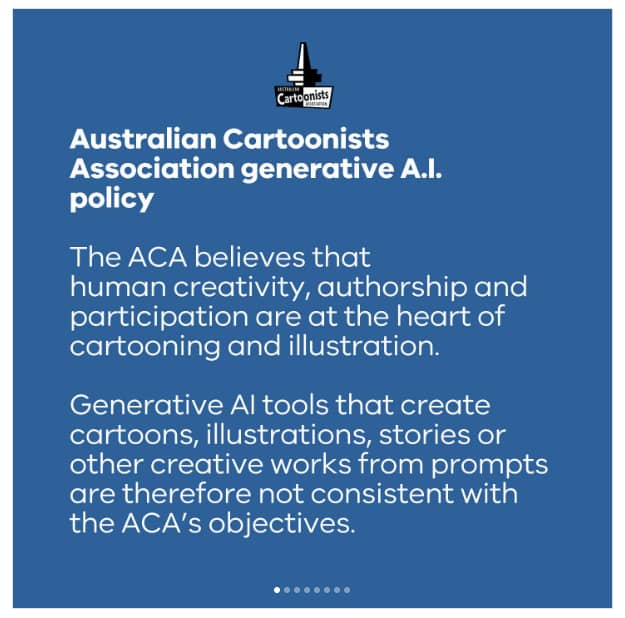
The association believes that human creativity, authorship and participation are at the heart of graphic design and illustration. Consequently, generative AI tools that create cartoons, illustrations, stories or other creative works based on prompts are not compatible with its objectives.
Furthermore, they point out that many generative AI systems have been trained using the work of artists, writers and other creators, both living and deceased, often without their knowledge or permission; that these platforms also require an overwhelming amount of energy to operate; and that these issues raise significant ethical concerns.
Whilst the association recognises that generative AI technology can be used as a tool for minor editing and production tasks, and that such technology can bring benefits in terms of accessibility for people with disabilities, it does not seek to prevent people from using assistive technologies that enable them to participate in the creation of cartoons, illustrations or texts.
However, they point out that their aim is to provide a forum for human artists and to encourage the creation of works of art by both professionals and the general public. This necessarily involves participating fully in the process of writing and drawing and being, in every respect, the creator of one’s own works – something that both people with and without disabilities do on a daily basis.
They support cartoonists, illustrators and writers, and encourage people to create, learn and develop their craft, ensuring that the value of human creativity remains at the heart of their work.“Technology can help the artist. It must not replace them,” they add.
Politics
- The ACA does not support the use of generative AI to replace the creative contribution of cartoonists, illustrators and writers.
- The ACA will not knowingly publish, exhibit or promote works that have been predominantly generated by AI. Such works will not be eligible for the Stanley Awards.
- This does not prevent the ACA from discussing, reviewing or educating members about generative AI and its impact on the cartooning and illustration industries.
- ACA members are expected to be transparent about their creative process and must not knowingly present predominantly AI-generated work as their own original creative work.
- Where there are reasonable grounds to believe that a work submitted, exhibited, published or entered in an ACA activity has been substantially created by generative AI, the member may be asked to provide reasonable evidence of their creative process and authorship.
- A member who knowingly represents predominantly AI-generated work as their own will have their membership status reviewed.