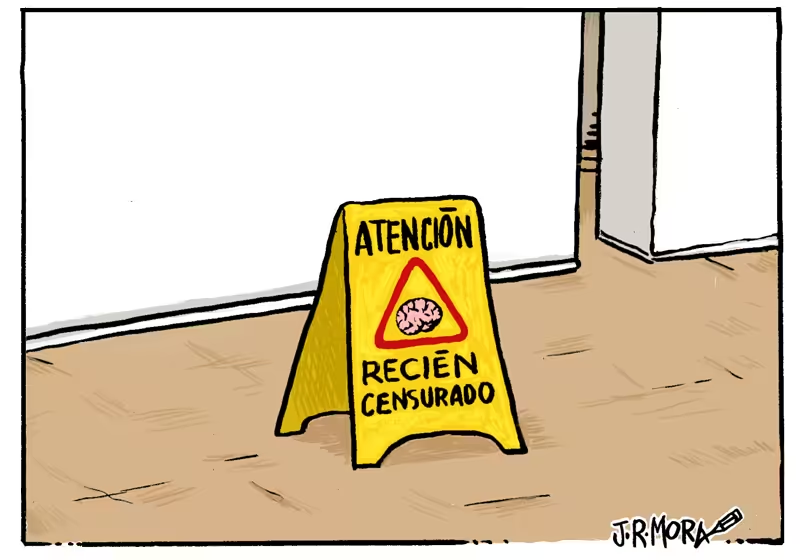
Translation of the cartoon: "Attention, just censored"
The year now gone has been a particularly difficult one for graphic humour globally, with cases ranging from editorial censorship and dismissals in traditional media to arrests and prosecutions on religious or political grounds.
Although the themes motivating the conflicts remain much the same as in recent decades, the increase in the number of cases is directly related to the authors' stance on the genocide being committed by Israel in Palestine, which shows that satire remains under pressure and walks an increasingly thin line between freedom of expression, censorship and (misunderstood) self-censorship.
So much so that 2025 opened with a new case of a media outlet deciding to stop publishing cartoons. "We will no longer publish political cartoons". This is how blunt the editor of the weekly The Latrobe Bulletin (Pennsylvania) was in a note in which he apologised for the publication of a cartoon by Lee Judge on the inauguration of Donald Trump, announcing that they were ceasing to publish political cartoons "so as not to divide".
Global Trend: "Cartooning for Peace" 2025
Cartooning for Peace is finalising a comprehensive monitoring project (2025-2026) due to the rise of digital threats. According to its preliminary reports this year, comedians are suffering more than ever from "organised trolling" and "algorithmic censorship" on social media, with activist groups getting platforms such as Instagram or X to suspend artists' accounts for alleged "hate speech" when they are merely engaging in political satire.
Cartooning for Peace, together with its partners, including Cartoonist Rights, will publish in early 2026 a follow-up report to the"Cartoonists on the line" report published in November 2023, which you can read here, to provide a comprehensive overview of the developments and threats faced by cartoonists, while incorporating new research data.
While that happens, here is a brief review of some of the most noteworthy cases of 2025 that I reviewed here or that were left pending publication or review. You can consult the rest of the events of 2025 in the list"Humour in trouble".
Turkey: The case of LeMan magazine

This was perhaps one of the most serious incidents of 2025. In July, several members of the staff of the iconic satirical magazine LeMan were arrested following the publication of this cartoon on the Middle East conflict.
The image, which shows two characters named "Mohammed" and "Moses" holding hands in the sky while missiles fall, provoked angry reactions. Although the magazine claimed it was a message of peace and did not depict prophets but ordinary people with those names, the Turkish authorities called it an "insult to religious values" and arrested cartoonist Doğan Pehlevan, editorial director Zafer Aknar, graphic designer Cebrail Okçu and manager Ali Yavuz.
In addition, police blocked access to the magazine's website and removed physical copies from newsstands. Pehlevan was remanded in custody until November 2025, when a court ordered his release under judicial supervision while the trial continued. However, according to the daily Cumhuriyet, Doğan Pehlevan, the only defendant in the investigation into his alleged depiction of Muhammad and Moses in the cartoon, could not be released because he was still accused of "insulting the president".
Zehra Ömeroglu acquitted of "obscenity" offence

In Turkey, the case of Zehra Ömeroglu, who was acquitted of an "obscenity" offence after a ludicrous legal challenge over a cartoon published during the pandemic, was also a high-profile case.
After five long years of a judicial process stretched by adjournments, finally, on Thursday 26 June 2025, the Istanbul Court of First Instance finally acquitted the Turkish cartoonist Zehra Ömeroglu.
The cartoonist was tried for an alleged offence of "obscenity" for a cartoon published in LeMan magazine in 2020 and faced a prison sentence of six months to three years and a fine.
United States: Ann Telnaes resigns from The Washington Post
In early 2025, the renowned cartoonist Ann Telnaes, winner of a Pulitzer Prize in 2001, was at the centre of one of the biggest editorial controversies in the US. Telnaes resigned from her position at The Washington Post after the newspaper refused to publish one of her critical cartoons.

Sketch of the rejected vignette
Ann Telnaes posted a note on her Substack page explaining why she was leaving her job at the newspaper.
The piece showed several tech tycoons (including Jeff Bezos, owner of The Washington Post) bowing to Donald Trump and offering him money. The paper considered the image too risque, or who knows, but decided that it would not appear in the paper, which Telnaes interpreted as an act of corporate self-censorship.
Half the world's media reported Telnaes' abandonment of this episode of blatant censorship by the newspaper.
Bob Whitmore, sacked and reinstated

And those who defend the genocidaires continue to try to silence those who dare to denounce the massacre. Thus, Bob Whitmore was fired from Creative Loafing, a small weekly in Tampa, Florida. His editor told him that he had received two letters describing his cartoon about the famine in Gaza as anti-Semitic. According to the author, the weekly was still considering issuing a letter of apology for publishing the cartoon.
Three days later, the weekly backed down and reinstated Bob Whitmore as a staff cartoonist after hundreds of readers flooded the email inboxes of corporate and local editors over its decision to fire him for a cartoon that only two readers called "anti-Semitic."
In the United States, others trying to silence cartoonists are the followers of the MAGA movement.

An event at the Buffalo Museum of History, which was to feature cartoonist Adam Zyglis (1982), was postponed after one of his cartoons sparked criticism of the author and The Buffalo Newspaper Guild that led to credible threats to the cartoonist and his family, including death threats, from supporters and sympathisers of the MAGA movement.
India: Hemant Malviya prosecuted in court

In July 2025, cartoonist Hemant Malviya faced the Supreme Court of India.
Malviya was arrested after he posted a cartoon on Facebook depicting a member of the Rashtriya Swayamsevak Sangh (RSS), a Hindu ultra-nationalist paramilitary organisation, and Prime Minister Narendra Modi. He was arrested by police following a complaint by RSS activist and lawyer Vinay Joshi.
He was charged with"disturbing communal harmony and religious sentiments" and"electronically sharing content depicting sexually explicit acts". Interestingly, the charges were based on old drawings (from the time of the pandemic in 2021) that were refloated by users to denounce him.
On 3 July, the Madhya High Court rejected his bail application, ruling that the RSS representative and the Chief Minister were depicted"in an undignified manner" and that the cartoonist's act was"deliberate and malicious and intended to offend the religious sentiments of the petitioner and the general public by insulting their religion, which is detrimental to the maintenance of harmony in society", some of the judges harshly criticised his language, noting that "freedom of expression is being abused" on social media to damage the dignity of the institutions.
Argentina: Legal tensions and increased repression
The climate for journalists and comedians in Argentina became considerably more tense during 2025, according to some reports on freedom of expression such as those of SiPreBA or ADEPA.
Nik (Cristian Dzwonik) vs AFA
Although the clash began in late 2024 over a parody of AFA president Claudio Fabián Tapia, nicknamed "Chiqui", the trial and the hackneyed debate over the limits of humour continued for much of 2025.
The origin of the conflict dates back to the last quarter of 2025, after the publication of a cartoon in which Nik parodied Claudio "Chiqui" Tapia, president of the Argentine Football Association (AFA), accused of corruption. Nik, now Javier Milei's official mouthpiece, got the wig to share the cartoon on his social networks.

Unlike Nik's previous disputes (mostly over a plethora of plagiarism allegations), this time the AFA, under the management of its lawyers, threatened the cartoonist with a lawsuit for "damages" and "insult to honour".
The drawing depicted Tapia in a way that the AFA considered "offensive and defamatory", linking him in a satirical way to shady handling of football money.
Sergio Langer and "Gaza in the crosshairs".
The cartoonist and son of a Holocaust survivor, Sergio Langer, promoted the exhibition"Gaza in the Spotlight" in which at least 30 other well-known artists participated. Although he did not face legal problems, he reported heavy pressure and criticism in an already politically polarised environment for his critical stance towards the state of Israel.

Langer's case in 2025 can be defined as a phenomenon ofinstitutional 'cancellation' and interest group pressure due to his stance on the Middle East conflict.
Although the problem did not come from the state, but from institutions of the Jewish community in Argentina and related sectors, he was accused of using tropes that bordered on anti-Semitism (a star catch-all used to try to silence any criticism) and the author maintained that his criticism was strictly political and humanitarian.
In an interview with Zoom magazine, Langer responded to accusations of anti-Semitism:
- What happens to you when your own "countrymen" accuse you of anti-Semitism for expressing your views on this massacre?
- I feel rejected and judged by my own family and friends, but I cannot betray my convictions, which are visceral. For me, being Jewish has always meant being anti-fascist. And to see in recent years guys like Trump, Bolsonaro, Abascal and Milei waving Israeli flags is unusual and abject.
Humour in trouble, a collection of cases
Cases of cartoonists who have had problems of some importance because of their cartoons or satirical illustrations. There are also some stories of other people who, without being cartoonists, have got into trouble for sharing them.