This week it emerged that a well-known cartoonist in Eritrea has been released after spending 15 years in detention without charge. Cartoonist Biniam Solomon, who signs "Cobra" and is now in his 60s, was arrested in 2011 in Asmara, the country's capital, but was never prosecuted and both the reasons for his arrest and his release are unknown.
During the 15 years he spent in prison he was barred from outside contact and his relatives told the BBC he received only sporadic medical attention and spent the last part of his detention in a "criminal investigation" prison, where other political dissidents are still held in harsh conditions.
While no one reported his arbitrary detention at the time, nor now his release, his release from prison is part of a recent series of similar releases. Thousands of people in Eritrea are still imprisoned incommunicado and without trial. The government has been accused of various human rights violations for years.
The absence of independent media in the country makes it difficult to obtain clues as to the reasons for his imprisonment and whether or not his prolonged captivity has anything to do with the content of his cartoons, although you don't have to be very clever to guess. There are thousands of political prisoners in Eritrea.
The author became known for his critical images touching on political and social issues, which were published in several Eritrean newspapers between 1997 and 2000. Despite having lost an arm in childhood, Biniam managed to build a career as an artist and created a considerable body of work, publishing three books, including a number of books compiling his work. To supplement his income, he also worked as a physics teacher at a high school in Asmara.
Their work developed in a brief period after Ethiopia's independence in which private media flourished, before they were shut down in September 2001. The government shut down the private press on the grounds that it "endangered national security" and several journalists were imprisoned.
The BBC piece adds what appears to be part of a Biniam strip satirising a period of growing uncertainty within the government in 2001, when a number of officials, including senior ministers, were "sidelined" and dismissed without warning.

In the picture, a minister's wife asks her husband why he doesn't get out of bed to go to work and he replies: "I may have been frozen (suspended)", adding that he is listening to the government radio to find out if he still has a job.
Amnesty International has previously warned of serious attacks on freedom of expression and reported on enforced disappearances in a country without any privately owned media. The free press was dismantled in 2001 when the government arrested 15 senior members of Eritrea's ruling People's Front for Democracy and Justice, known as the G-15, along with 16 journalists who supported them, after they demanded that President Afwerki implement the draft constitution and hold free and open elections. The whereabouts and fate of these politicians was unknown, as were the journalists accused of links to the G-15.
Several human rights organisations have frequently documented widespread abuses in Eritrean prisons with deplorable living conditions, including lack of contact with the outside world, insufficient food and medicine, severe physical abuse and increasing mental health problems.
According to the UN, in 2012 there were about 10,000 people arrested and detained without trial in Eritrea for political reasons. The Eritrean authorities have consistently denied these allegations.
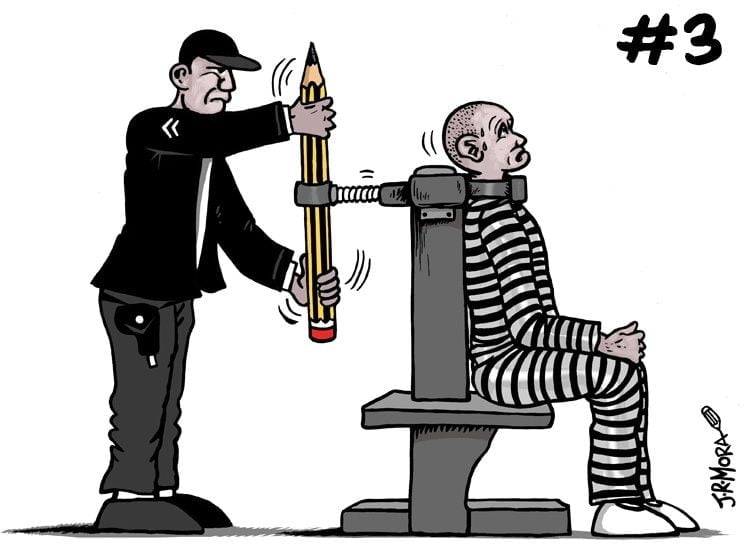
Humour in trouble, a collection of cases
Cases of cartoonists who have had problems of some importance because of their cartoons or satirical illustrations. There are also some stories of other people who, without being cartoonists, have got into trouble for sharing them.