


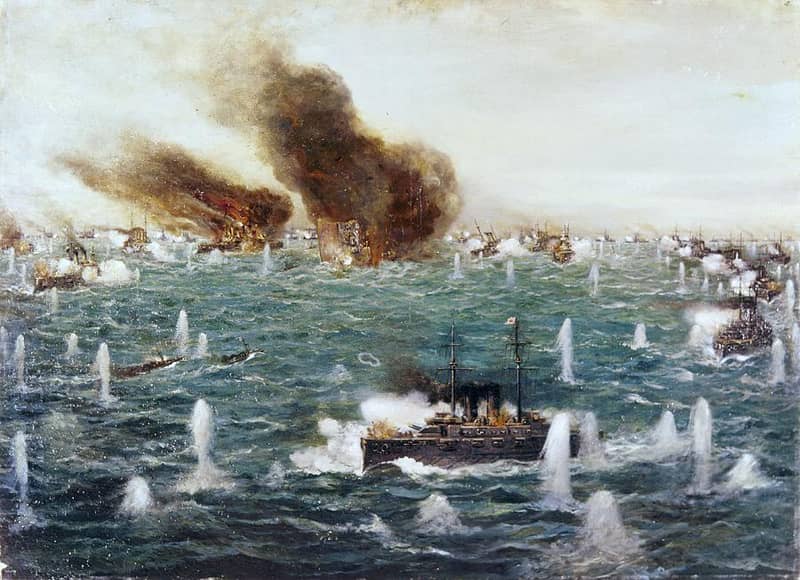
The Battle of Tsushima, 1905, painting by Tōjō Shōtarō. By Tōjō Shōtarō – Public domain.
The Russo-Japanese War (1904–1905) was a pivotal conflict in modern history and is regarded as one of the first‘total wars’. It came to be described as‘World War Zero’, marking Japan’s rise as a world power whilst also exposing weaknesses in the Russian Empire – a development which, for some historians, foreshadowed the 1905 Revolution.
The first major war of the 20th century pitted a rising Japan against the Russian giant. In less than two years, it altered the balance of power in Asia. Japan’s victory over Russia – its first ever victory over a European country – transformed the international landscape at a time when colonialism was beginning to take hold.
The cause of the war was the rivalry for control of Manchuria and Korea between Russia (which was extending the Trans-Siberian Railway and seeking ice-free ports, such as Port Arthur, now Lüshunkou) and Japan (which regarded Korea as a vital enclave for its security).
War Breaks Out
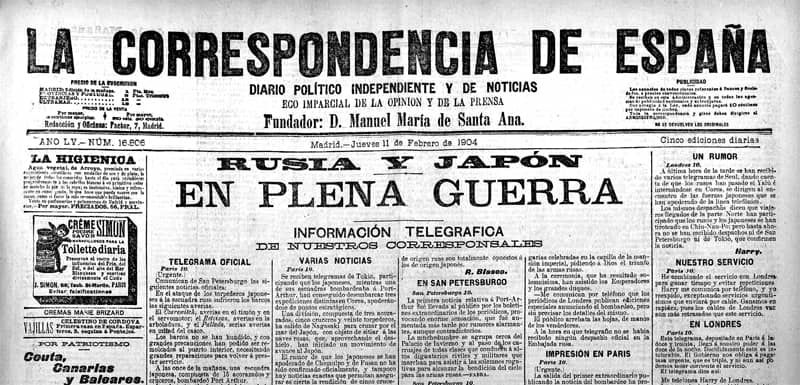
It all began on 8 February 1904 when Japan launched a surprise attack on Port Arthur without a formal declaration of war, an action similar to its strategy against China in 1894 and one it would repeat in 1941 at Pearl Harbour.
The main battles of this war were the Battle of Port Arthur (a prolonged siege and its fall in January 1905), the Battle of Mukden (February/March 1905, the largest land battle to date) and the Battle of Tsushima in May 1905, which marked the decisive Japanese victory, destroying two-thirds of the Russian Baltic Fleet and is regarded as one of the greatest naval battles in history and the greatest naval defeat of Tsarist Russia.
The conflict came to an end following mediation by US President Theodore Roosevelt, with the Treaty of Portsmouth (text of the treaty) signed on 5 September 1905. Japan gained Port Arthur, the southern half of Sakhalin and recognition of its influence in Korea.
The View from the East and the West
From the outset of the tensions, media outlets around the world followed the conflict very closely, and the first news reports, accompanied by cartoons, began to appear in the international press. This compilation brings together some of those images, as well as those published in the countries involved in the conflict, in the United States, and also in Spain and other countries.
In Japan, Western-style satirical magazines featured cartoons glorifying Admiral Tōgō (hero of Tsushima) or caricaturing Tsar Nicholas II, whilst the Russian Empire was portrayed as a drunkard, an ugly monster or a huge, ferocious bear tamed by Japan, which was depicted as a small but skilful samurai, although in other scenes he was also depicted as a fox.
Tokyo Puck was a famous Japanese satirical and cartoon magazine, founded in 1905 by the cartoonist Kitazawa Rakuten. Its name was a statement of intent; it was modelled on the American magazine *Puck*. The magazine was launched against the backdrop of the war and, in its early days, was critical of the government; several issues were banned. However, following the‘high treason incident’of 1910, it adopted a more conservative stance and focused more on matters of everyday life.
Later, another Asian version of the American *Puck* appeared. In 1906, *Osaka Puck* was founded, with the Western-style artist Akamatsu Rinsaku playing a key role. Its format set it apart from *Tokyo Puck*.
Many Japanese artists, such as Kobayashi Kiyochika (1847–1915), Toshihide Migita (1862–1925) and Kabaragi Kiyokata (1878–1972) produced numerous patriotic-style colour woodblock prints, as well as a large number of photographs, paintings and illustrations during the Russo-Japanese War.
The covers of Puck (USA)
In the Western press, particularly in the United States, magazines such as *Puck* and *Judge*, which initially supported Japan asa ‘victim’ of Russian expansionism, later began to express concern about its rise, drawing on the racist ideology ofthe ‘Yellow Peril’ and fuelling the theory that China and Japan had formed an alliance to conquer and enslave the Western world.
Japan was often portrayed as a wasp or a tiny but effective soldier standing up to an oversized, yet corrupt and medieval, Russian Empire.
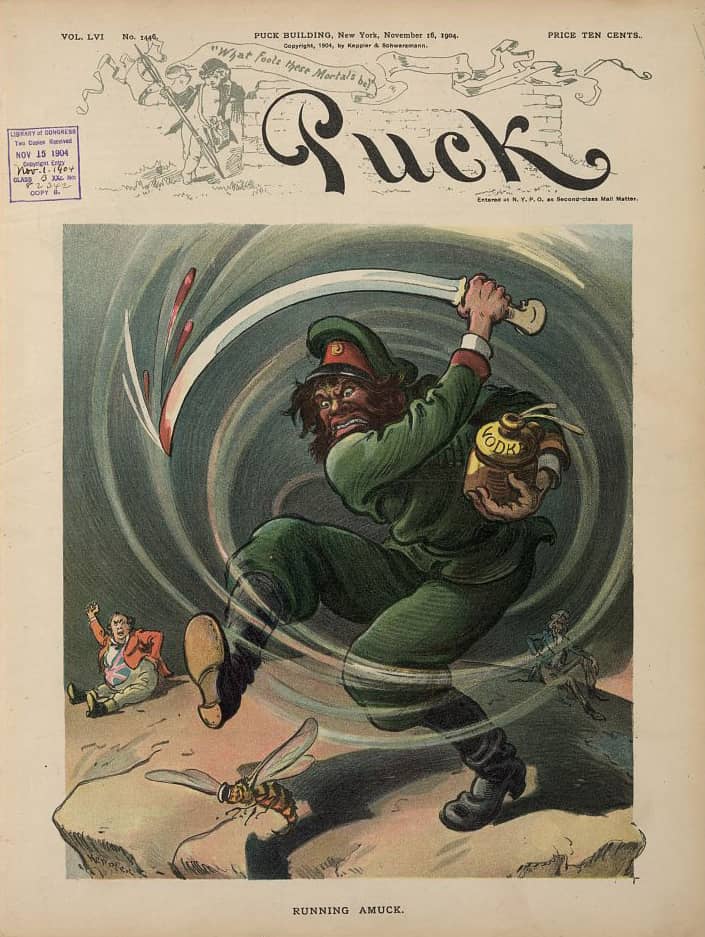
16 November 1904. No. 1446. The illustration by Udo J. Keppler (1872–1956) depicts a drunken Russian soldier holding a jug of vodka and wildly brandishing a bloodstained sword at a wasp representing Japan. John Bull (Great Britain) and Uncle Sam (USA) are seated in the background. At the bottom, the caption reads ‘Going mad’. Library of Congress, USA.
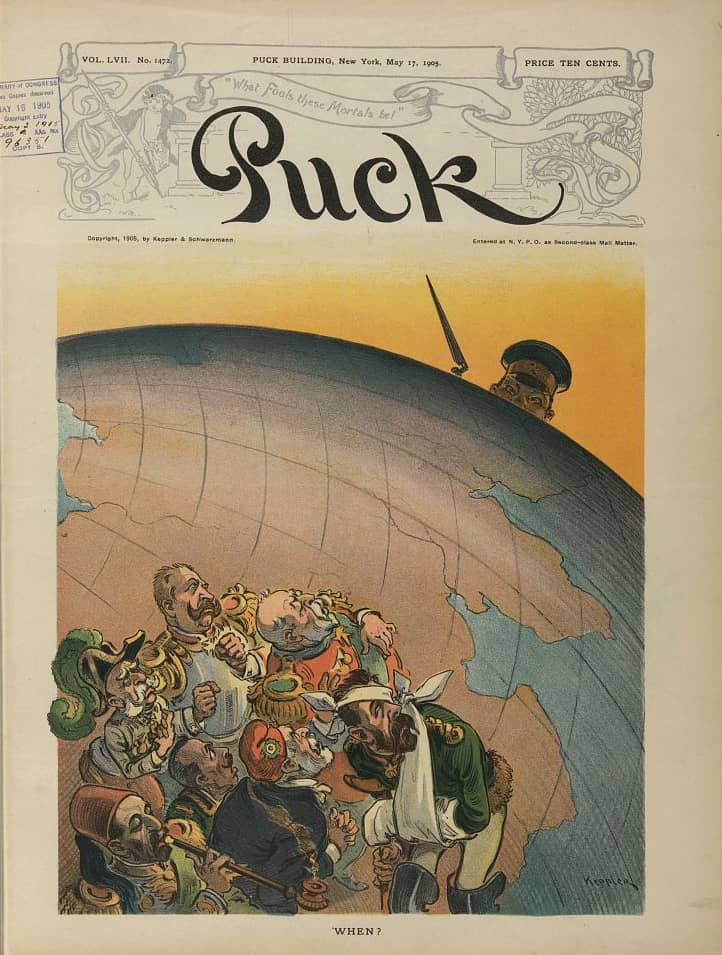
17 May 1905. Cover of issue No. 1472 by Udo J. Keppler. The scene depicts Mutsuhito (Meiji), the Emperor of Japan, peering from the east over the top of a large globe towards Europe, where the rulers of various nations are gathered alongside Nicholas II, the wounded and crippled Emperor of Russia; there is concern amongst European leaders as to where Japan will turn next after defeating Russia. At the bottom, the caption reads ‘When?’. Library of Congress, United States.
In the United Kingdom, an ally of Japan since 1902 following the signing of their alliance to curb the expansionism of the Russian Empire in the ‘Far East’ and protect the territorial interests of both empires in Asia, the magazine *Punch* portrayed the Japanese as civilised and heroic, which contrasted with the Asian stereotype of the time. Almost the entire rest of the British press also sided with Japan.
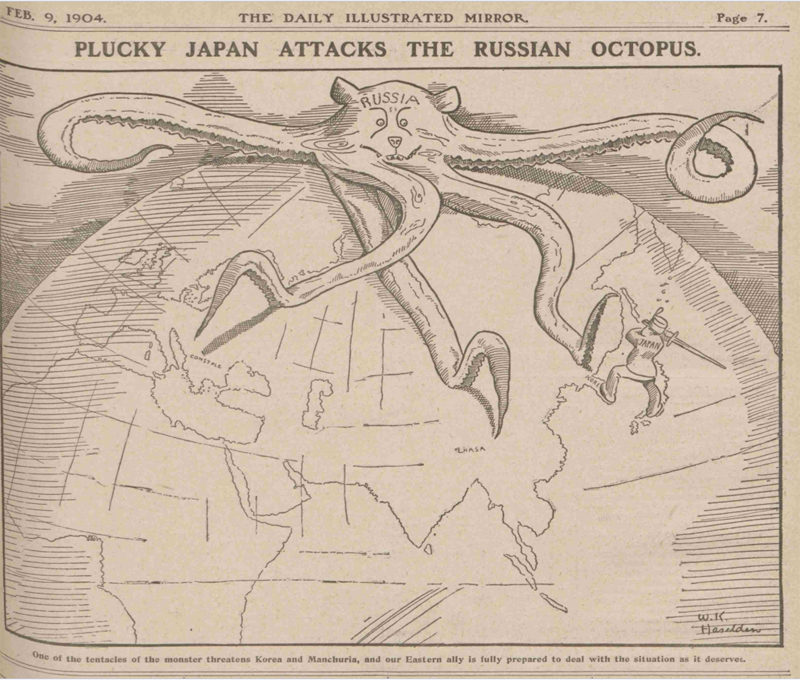
Cartoon by William Kerridge Haselden, published on 9 February 1904 in the Daily Illustrated Mirror. Caption: “Brave Japan attacks the Russian octopus” (depicted with a bear’s head). Caption text: “One of the monster’s tentacles threatens Korea and Manchuria, and our eastern ally is fully prepared to deal with the situation as it deserves.”
The front page of that day’s *Daily Illustrated Mirror* was also devoted to the war. The image, entitled ‘The Squadron on the Lookout’, bears the following caption: ‘Japanese ships are patrolling off Wei-hai-wei, ready to engage the Russian warships coming from Europe. Their relentless mission is to prevent reinforcements from reaching the Russian fleet, which is known to be stationed off Port Arthur.”
Ten days later, they published another front-page article featuring an unsigned illustration depicting a drastic episode of military discipline within the Russian command, under the headline: “A Russian officer dies after being shot by his commander”. The caption reads:“When Japanese torpedo boats attacked the Russian fleet at Port Arthur, several Russian officers were ashore attending a circus. A correspondent in St Petersburg telegraphed that Admiral Alekséyev had conducted an inquiry into their conduct and, convinced of a lieutenant’s guilt, drew his revolver and shot the young officer dead in the presence of his colleagues.”
Its front page also featured the following headline, written with obvious sarcasm: “THE CRUELTY OF‘HOLY RUSSIA’. Japanese refugees brutally treated in Port Arthur”.
In France, a country with a long tradition of satire, publications such as *Le Rire* or *L’Assiette au Beurre* focused more on criticising Russia (due to its alliance with France) or on aspects of Japan’s exoticism. Much of Russia’s funding for the war against Japan came from France. Under the Franco-Russian Alliance signed in 1892, the French government and a consortium of major Parisian banks, such as Crédit Lyonnais, issued large loans that enabled Tsar Nicholas II to cover the costs of his war effort against Japan.
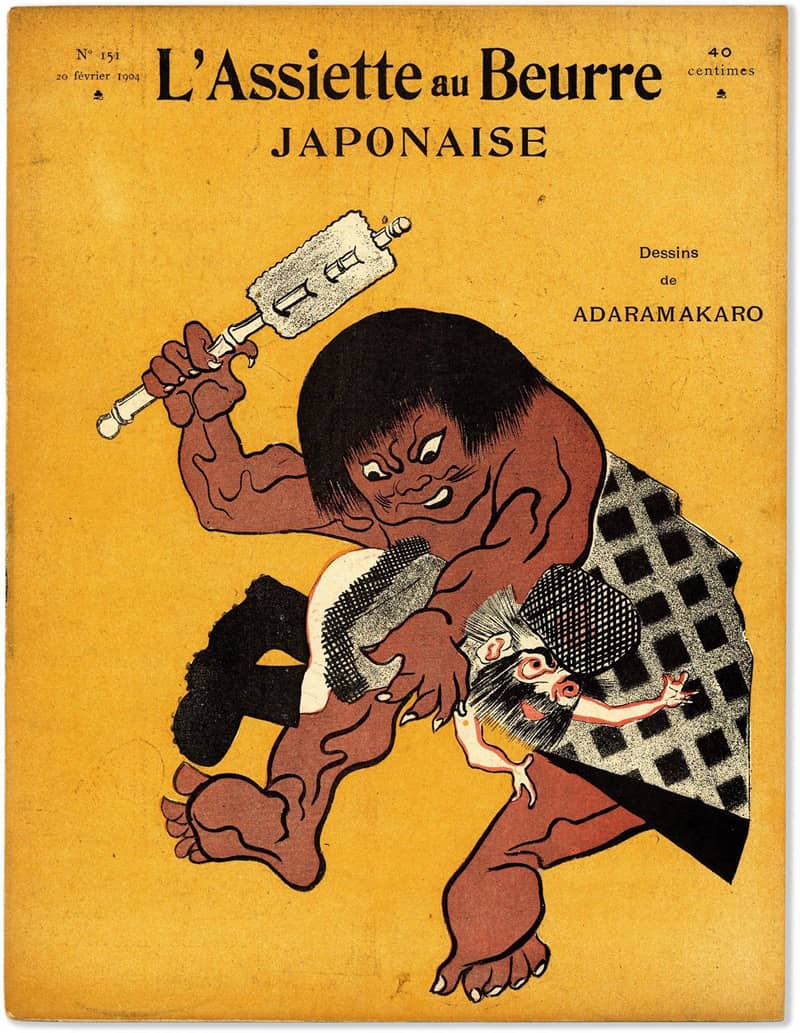
L'Assiette au Beurre was a French satirical magazine with anarchist, anti-clerical and anti-colonialist leanings, which was published between 1901 and 1936. In its 151st issue of February 1904, at the start of the Russo-Japanese War, the magazine devoted its entire contents (16 pages) to scathing political cartoons in which Adaramakaro caricatured the main protagonists. On the front cover, a Japanese woman is whipping a small Russian man.
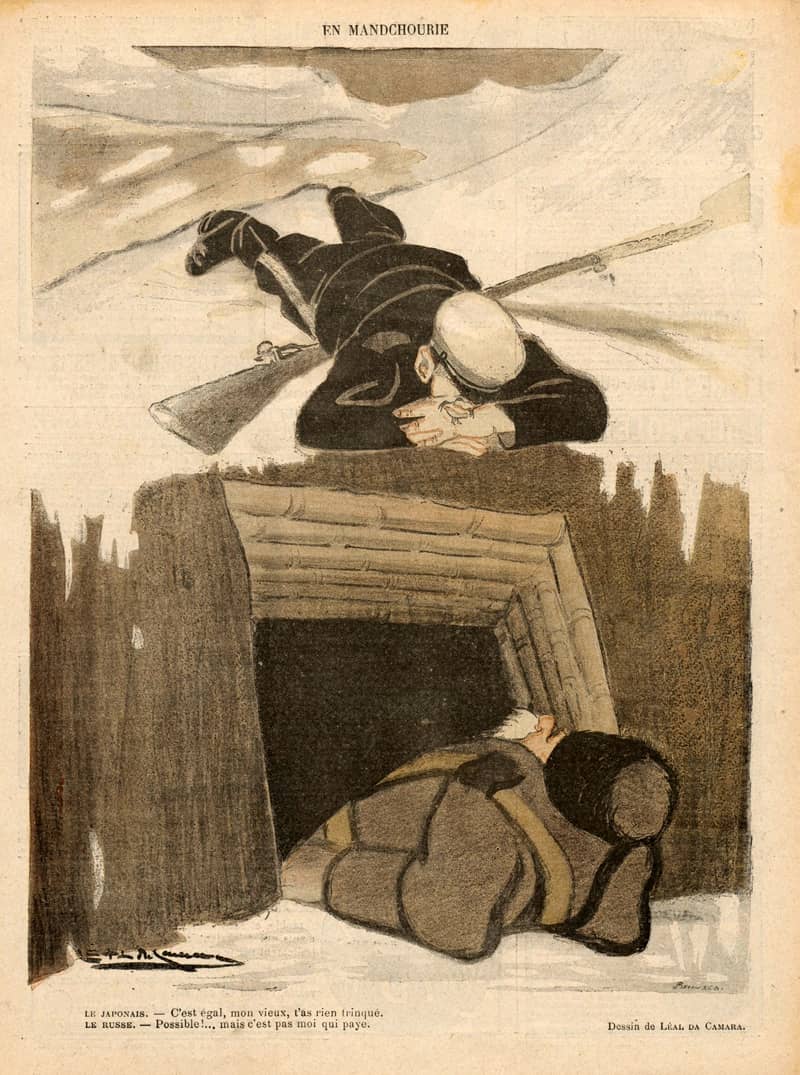
A full-page illustration entitled ‘In Manchuria’, depicting the main land front of the Russo-Japanese War. It was published in *Le Rire* in 1905. This magazine was one of the most influential and iconic satirical magazines of the Belle Époque.
In the scene, a Japanese soldier is talking to a Russian who is peering out of his trench or log-fortified bunker.
THE JAPANESE MAN. — Even so, old friend, you’ve really been given a beating.
THE RUSSIAN. — Maybe so!... but it’s not me who’s paying.
The artist is Tomás Leal da Câmara (1876–1948), a renowned Portuguese painter, caricaturist and illustrator with republican leanings. Due to political difficulties in Portugal – having been charged with a press offence for his cartoons criticising the political and social situation in his country – he went into self-imposed exile in Spain between 1898 and 1900. There, he worked for well-known publications such as *Madrid Cómico*. He later settled in Paris, becoming one of the leading illustrators for other top-tier French satirical magazines such as *L’Assiette au Beurre * and *Le Canard Sauvage*.
In Russia, magazines often depicted the Japanese using stereotypes such as geishas, clumsy samurais or ‘dangerous yellow men’, reflecting the racism of the time; however, there were also criticisms of the Russian government for its military incompetence and cartoons depicting the Tsar being duped by inept advisers, or the Russian fleet as a clumsy bear facing a cunning fox (Japan).
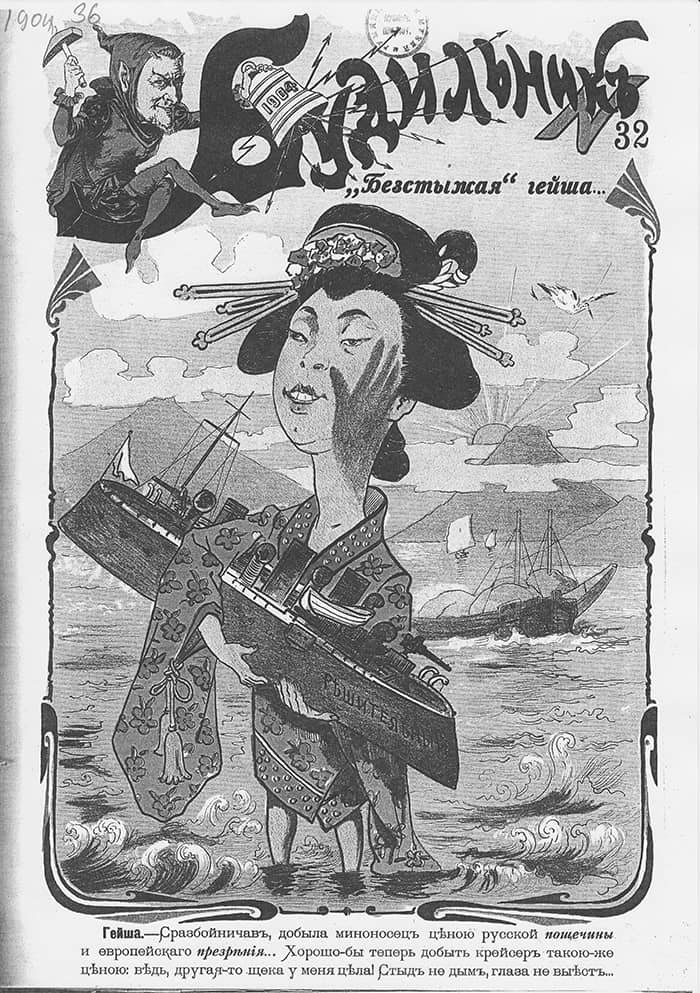
Under the headline ‘The “shameless” geisha…’ in issue 32 of Budilnik magazine, a geisha was depicted holding a ship. This is the Russian destroyer‘Reshitelny’, which was captured by the Japanese in August 1904 in the neutral port of Chefoo, China – an incident that caused great international outrage.
The caption reads:“Geisha: —Acting like a bandit, I managed to get hold of a destroyer at the cost of a Russian slap in the face and European contempt... It would be nice to get a cruiser now for the same price: after all, my other cheek is still intact! Shame isn’t smoke; it won’t blind your eyes...”
The closing line is an expression used cynically to suggest that shame or dishonour do not cause any real physical harm, which is why this character does not mind losing his reputation or dignity so long as he gains a material benefit (in this case, the warships). The mark of the black hand on his cheek represents that ‘slap’ or moral humiliation he has suffered.
The Budilnik (in Russian, Будильник, ‘The Alarm Clock’) was a satirical weekly published between 1865 and 1871 in St Petersburg and between 1873 and 1917 in Moscow.
Source: Caricature in History : ‘Butterfly’ Herself? Satirical Journalists on Japan, 1904–1905 / Russian Historical Society.
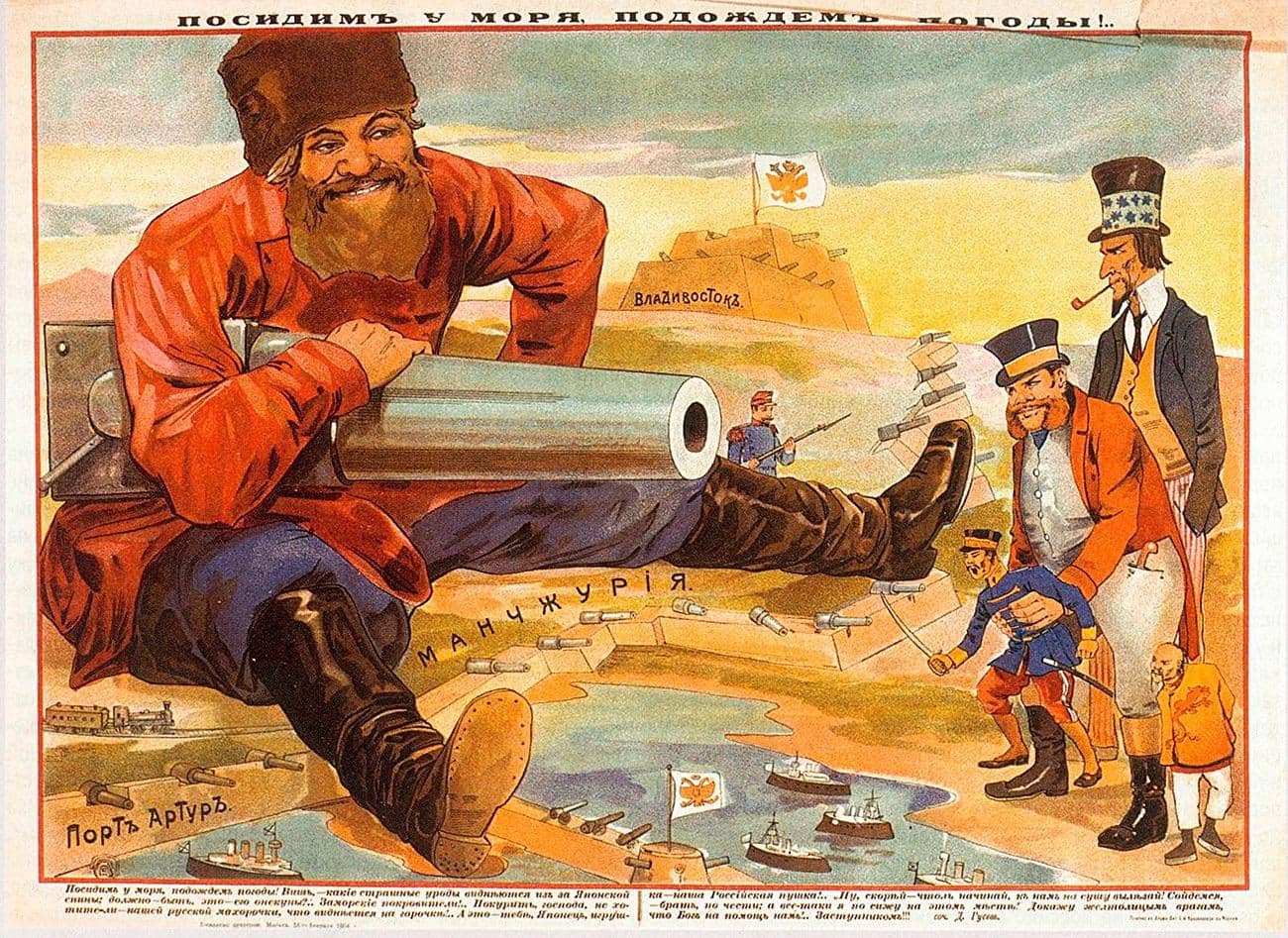
(To read the text below the image, tap the red circle above it)
This is a very typical example of lubok (лубок), a style of Russian folk art that combined simple illustrations with narrative or satirical texts. At the outbreak of the war in 1904, official Tsarist propaganda made extensive use of these prints to instil confidence in the population, portraying the Russian soldier as a good-natured, invincible giant facing small, ridiculous enemies.
This illustration was published just two weeks after hostilities broke out. An imposing Russian peasant or soldier (muzhik), wearing a traditional beard and cap, is comfortably straddling the region of МАНЧЖУРІЯ (Manchuria). His right foot rests on the fortifications of Портъ Артуръ (Port Arthur), whilst his left elbow points towards Владивостокъ (Vladivostok), the two key strategic points for the Russian navy in the Pacific.
On the other side, the enemies appear: Uncle Sam (USA) and John Bull (UK), who is holding a tiny Japanese soldier. Behind them is a dignitary from the Qing dynasty (China), who also appears to be tiny.
The mystery of the Japanese cartoons in *The New Zealand Graphic*
Special mention should be made of the illustrations – particularly those glorifying Japan – which were published in the New Zealand newspaper *New Zealand Graphic *.
The New Zealand Graphic and Ladies’ Journal (1890–1908), later known as the Weekly Graphic and New Zealand Mail (1908–1913), was an illustrated weekly magazine featuring a wide variety of literary pieces, special reports, society gossip and fashion features. It was the first publication of its kind to use photogravure in New Zealand.
This weekly magazine achieved a satirical milestone in its issue of 8 July 1905 when, for the first time, a New Zealand magazine published cartoons from a foreign perspective. It was an intriguing series of Japanese propaganda cartoons about the Russo-Japanese War.
When readers looked at this series of cartoons, published without a byline, they were unsure whether the magazine supported or opposed the war. Some images seem to suggest that the war would simply spark a revolution in Russia, whilst others viewed Japan’s rise as a military and economic power in the Pacific with fear.
Although they also published cartoons from a Western perspective, it is unclear why these Japanese propaganda prints, reflecting the patriotic viewpoint of Japanese propaganda, were published. What little is known on the matter is that the prints were originally distributed in colour in Japan as a propaganda leaflet (possibly by the publisher Tomizato Nagamatsu), and it is speculated that a journalist or traveller may have obtained a copy of these illustrations, which were later passed on to the magazine. (Source)
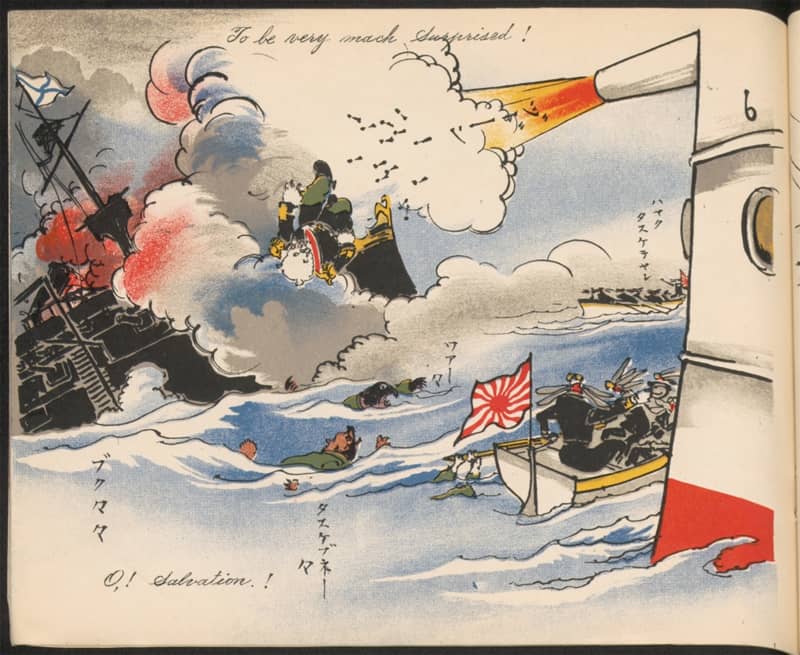
A scene from a naval battle. A Japanese ship sinks a Russian ship. The ‘White Bear’ (a satirical representation of the Russian Empire, personified specifically as a high-ranking military officer or the Tsar himself in the form of a polar or Arctic bear) can be seen flying through the air from the Russian ship, whilst Chinese labourers flee towards the Japanese ship.
There is a collection of Russian-Japanese propaganda illustrations, including woodblock prints, in the library of Cornell University’sKroch Asia Rare Materials Archive, where the original colour versions of the prints reproduced in the *New Zealand Graphic* can be viewed. The archive also provides English translations of the Japanese text appearing on the prints.
Spain’s neutrality
Just three days after the war had begun, Spain ordered its subjects to observe “the strictest neutrality”. Thus, on Thursday 11 February 1904, the order was published in the Gaceta de Madrid (also known as the Gazeta de Madrid), the name given between 1661 and 1936 to what we now know as the Boletín Oficial del Estado (BOE).
Ministry of State: Policy Section.—Cessation of hostilities between Russia and Japan.—Order from His Majesty’s Government that Spanish subjects observe the strictest neutrality with regard to the two belligerent Powers, in accordance with the laws in force and the principles of public international law.
Seven days later, in the satirical magazine ¡Cu-Cut!, on page 109 of its 112th issue dated 18 February, our neutrality was mocked.
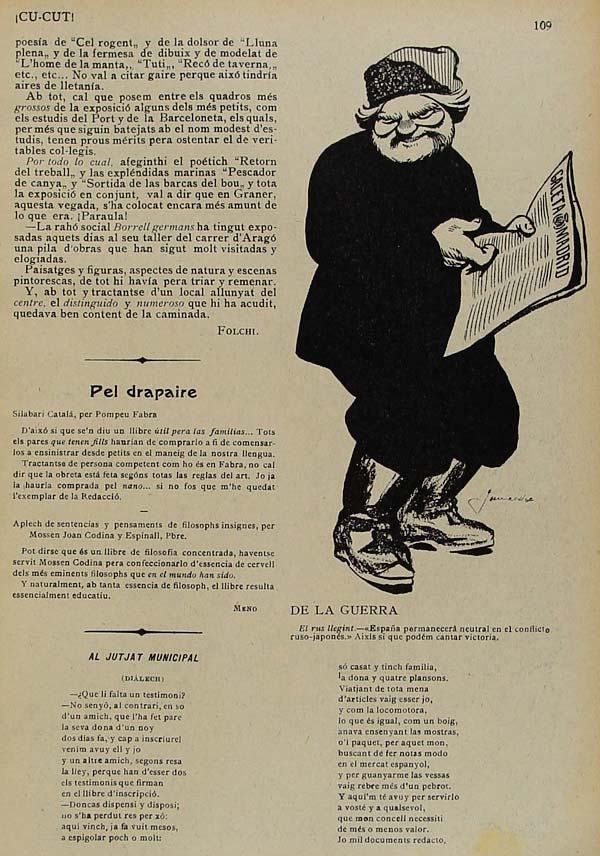
In the illustration by Joan García-Junceda i Supervia entitled ‘ON WAR’, a Russian man wearing a traditional fur hat (an ushanka or similar) is shown reading the *Gaceta de Madrid*, accompanied by the caption:
—“Spain will remain neutral in the Russo-Japanese conflict.” Now that’s something to celebrate.
The front cover of that same issue, illustrated by Cayetano Cornet i Palau ( 1878–1945), was also devoted to the conflict between the Russians and the Japanese and contained a number of other cartoons alluding to the war. You can read this issue in full here. ¡Cu-Cut! published a large number of jokes relating to the conflict.
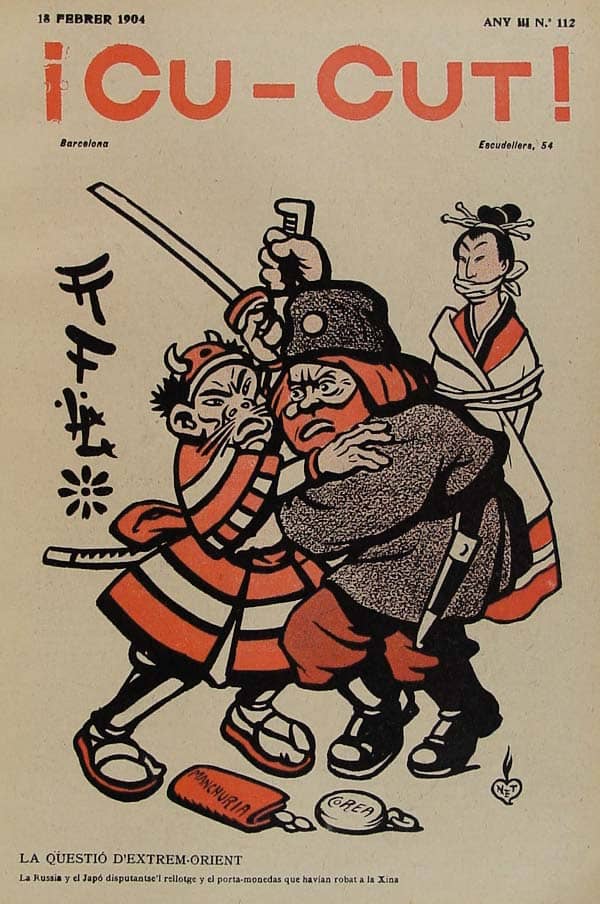
In the foreground, a Japanese soldier (wearing traditional samurai attire) is locked in hand-to-hand combat with a Russian soldier (wearing his characteristic fur hat and thick coat). The Japanese soldier is brandishing a katana, whilst the two grapple aggressively. At their feet lie the objects of the dispute, depicted as stolen everyday items. These consist of an open purse or coin purse, from which coins are spilling out, labelled ‘MANCHURIA’, and a pocket watch, labelled ‘KOREA’.
In the background, on the right, a Chinese woman in traditional dress can be seen; she has been gagged and tied to a post, forced to stand motionless and watch as the two soldiers fight over the belongings they have just stolen from her.
The caption reads: ‘The Far East question. Russia and Japan squabbling over the watch and purse they had stolen from China’.
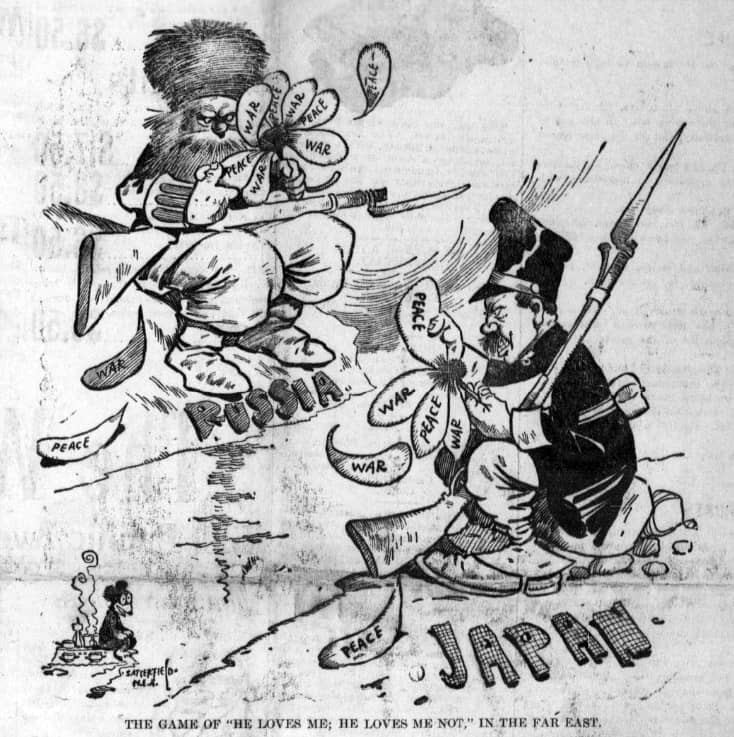
Translation: "The 'he loves me, he loves me not' game in the Far East."
The cartoon by Robert William Satterfield (1875–1958), known as Bob Satterfield or ‘Sat’, captured the pre-war atmosphere between the two powers. Russia and Japan playing the classic ‘he loves me, he loves me not’ game by plucking the petals off daisies, with the words ‘War’ and ‘Peace’
This was published on 15 January 1904 in *The Tacoma Times*. The initials ‘N.E.A.’ just below the author’s byline stand for the Newspaper Enterprise Association, a US newspaper trade union founded in 1902 by Edward Willis Scripps. Satterfield worked for this agency, which is why his cartoons on international politics were published simultaneously in local newspapers across the country. The cartoonist used to sign his work with what is known as‘Sat’s Bear’, a character who would depict an extra scene or a playful nod, or add an additional comment to the cartoon.
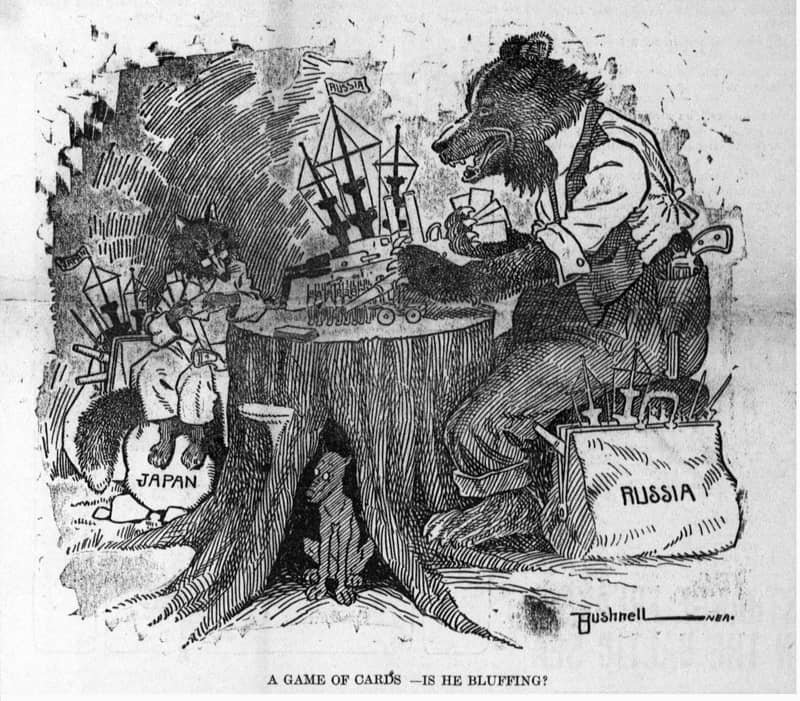
Translation: A game of cards. Is he bluffing?
Cartoon by Elmer Andrews Bushnell (E.A. Bushnell) 1872–1939, published in *The Tacoma Times* (Washington) on 22 January 1904.
The Russian Empire, represented by a bear, and the Empire of Japan, depicted as a fox, are playing a game of cards, staking their respective arsenals. Both are wondering whether the other is bluffing. The Russo-Japanese War would begin 17 days later.
Bushnell worked for newspapers in Ohio and New York. He is remembered for an illustration he created to mark the ratification of the Nineteenth Amendment, depicting the opportunities opening up for women with the right to vote. The image, entitled‘Now the Sky’s the Limit’, was published in the Sandusky Star-Herald on 23 August 1920.
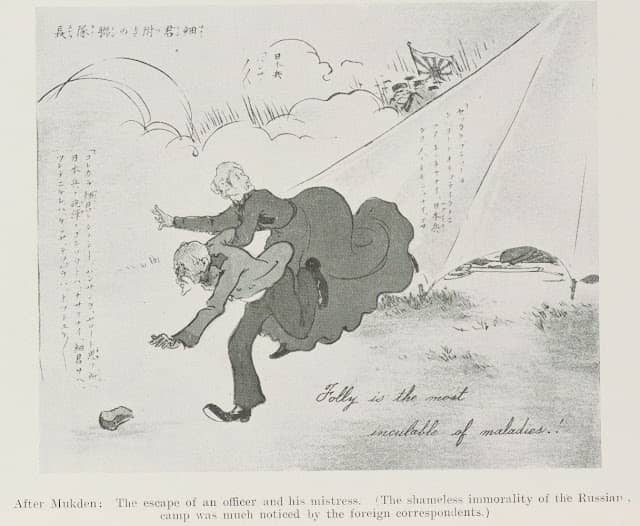
"After Mukden". The escape of an officer and his lover. Cartoon from the *New Zealand Graphic*, 8 July 1905. Auckland Libraries Heritage Collections NZG-19050708-28-2
Translation of the text above the cartoon: “Madness (or folly) is the most incurable of all diseases”. Caption: “After Mukden: The flight of an officer and his mistress. (The shameless immorality of the Russian camp was much discussed by foreign correspondents).”
When the Japanese attacked the Russians during the Battle of Mukden, they almost succeeded in encircling their troops. The cartoon shows a Russian officer fleeing with his mistress during the panic-stricken retreat that followed the collapse of the Russian rearguard.
Another recurring theme in the cartoons was the Russian Revolution of 1905, which quite a few media outlets used to link to the defeat by Japan, either as a consequence or even as a cause.
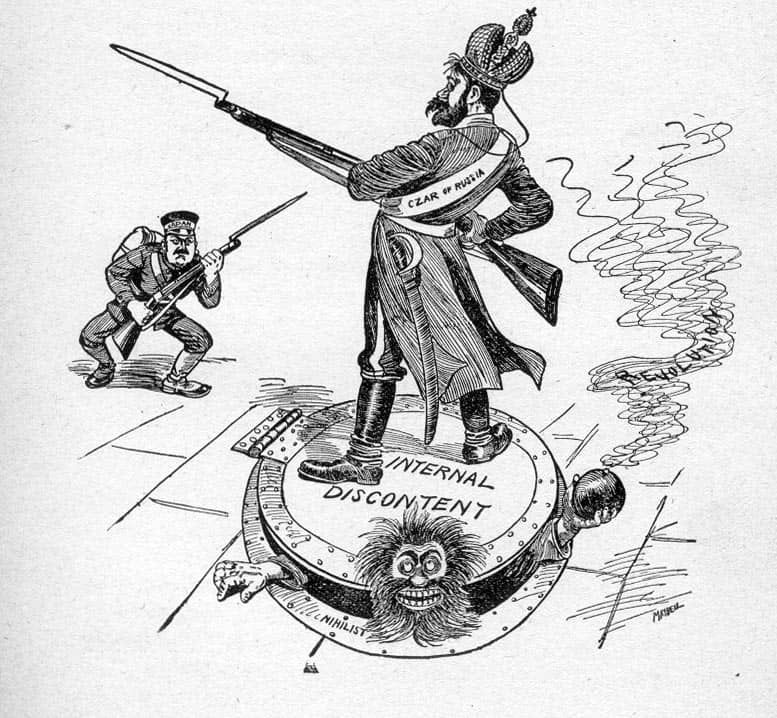
In this cartoon by Claude Maybell, most likely published in late 1905 or early 1905 in the San Francisco Chronicle (the newspaper for which he worked at the time), a spatial metaphor is used to illustrate the two destructive fronts besieging the Tsarist government of Nicholas II.
In the centre, the Tsar of Russia, wearing his imperial crown and military uniform, aims his rifle, with the bayonet fixed, at a Japanese soldier who is advancing resolutely towards him. The Tsar, completely focused on the external conflict, fails to realise that internal discontent is brewing at his feet. A figure with unkempt hair and beard and a deranged expression peeks out from the trapdoor, labelled ‘NIHILIST’ (the term used in the West to group together Russian revolutionaries, anarchists and anti-war agitators). In one hand he holds a lit bomb, from whose fuse billows a thick black plume of smoke that spells out the wordREVOLUTION.
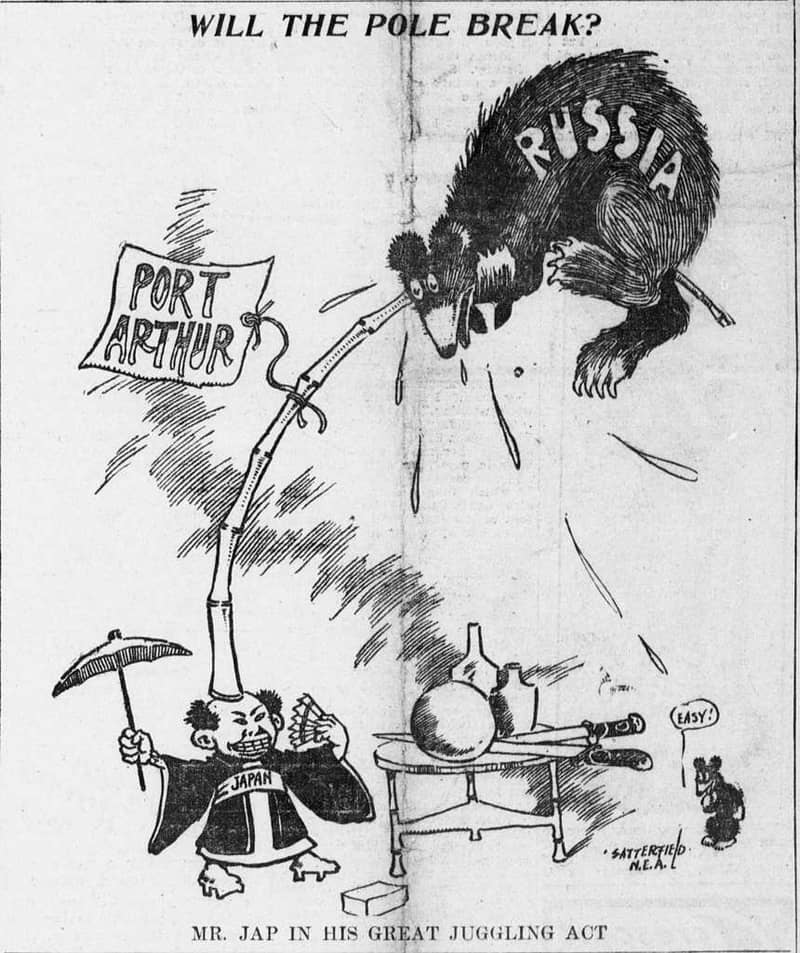
Translation. Title: ‘Will the stick break?’. Caption: ‘Mr Japan performing his great juggling act’.
Bob Satterfield drew a number of cartoons relating to the conflict between Japan and Russia, such as this one, which also appeared in *The Tacoma Times* on 20 July 1904, in which the personification of the Empire of Japan balances a bamboo pole bearing the inscription ‘Port Arthur’ on her head, with the Russian bear teetering even more precariously at its tip. Eleven days after this cartoon was published, the siege of Port Arthur began.
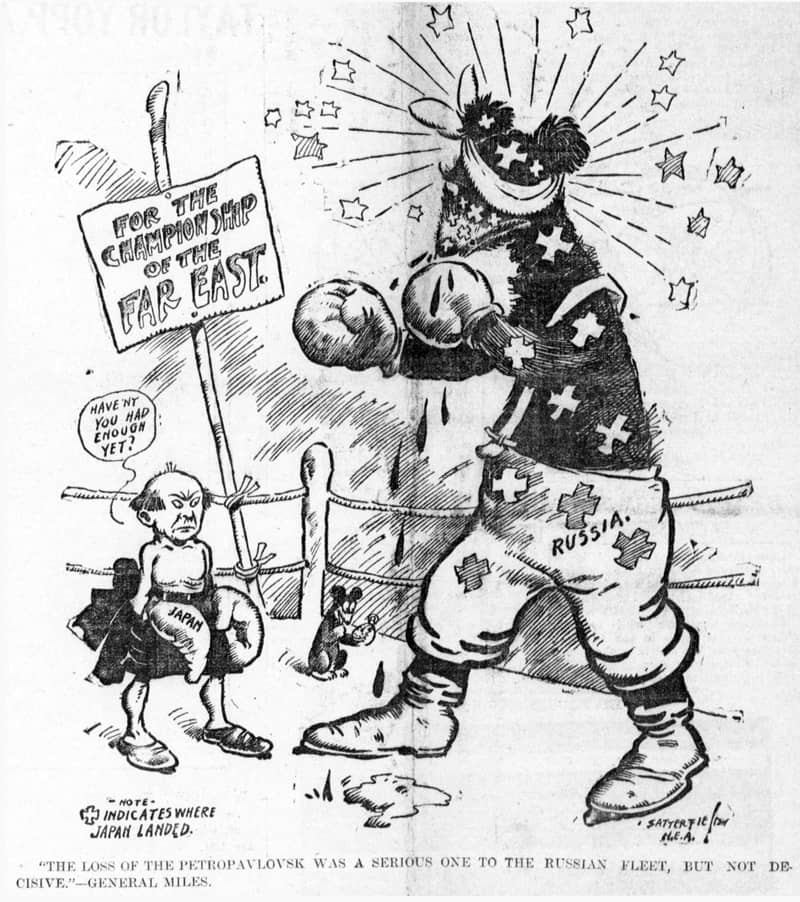
Translation of the text at the bottom of the cartoon: “The loss of the Petropavlovsk was a serious blow to the Russian fleet, but not a decisive one.”—General Miles.
In Bob Statterfield’s cartoon of 21 April 1904 in *The Tacoma Times*, the Russian bear raises his paws, clad in boxing gloves, as he challenges a Japanese boxer to the ‘Far East Championship’, to which the boxer replies: “Haven’t you had enough yet?”. The numerous bandages covering the bear’s body and boxing shorts indicate the heavy losses suffered by Russia. In the background, Satterfield’s bear mascot checks a stopwatch to see how much longer the fight will last.
The Petropavlovsk was the Russian flagship that sank after striking one or more Japanese mines off Port Arthur in April 1904. Its sinking claimed the lives of Admiral Makarov, the renowned war painter Vasily Vereshchagin – who was making sketches for future paintings – the Chief of Staff of the Pacific Squadron, Rear Admiral Mikhail Molas, ten officers and 18 naval officers, two doctors, a priest and two military officers. Some 650 sailors also perished on the battleship, resulting in a national tragedy for Russia and a devastating loss that propaganda sought to downplay. Some consider this episode to have been one of the factors that hastened Russia’s ultimate defeat.
In 2012, the remains of the Petropavlovsk’s hull – 70 metres long and 13 metres wide – were found at a depth of 34 metres, near Port Arthur (Lüshunkou).
Treaty of Portsmouth
The Treaty of Portsmouth brought the war to an end. It was signed on 5 September 1905 at the Portsmouth Naval Shipyard in Kittery, Maine, United States. The then US President, Theodore Roosevelt, acted as a mediator in the negotiations, for which he was awarded the Nobel Peace Prize in 1906.
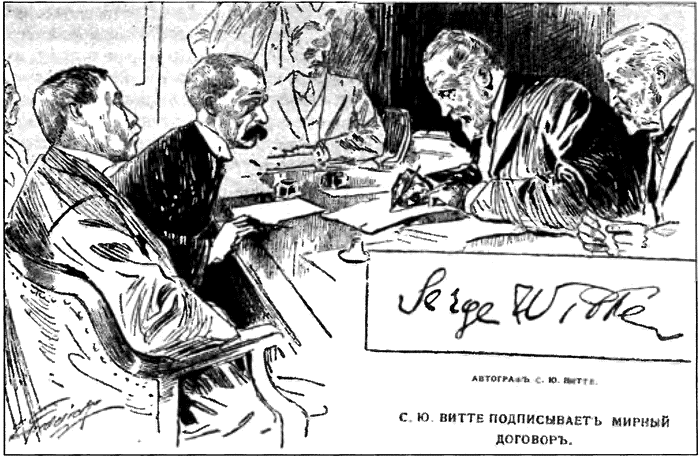
Komura Jutarō (1855–1911), on the left, watches as the Russian representative Sergei Witte signs the treaty documents. In the background is Herbert H.D. Peirce, an official from the US State Department. Photographers were not permitted in the conference room, but a member of the Russian delegation produced this sketch, which was sent to St Petersburg and distributed to the foreign press. Taken from *Lietopis Voiny's Yaponye* (Chronicle of the War with Japan).
Japan and Russia agreed to evacuate the Manchuria region and return sovereignty over this territory to China, but Japan was granted a ‘concession’ over the Liaodong Peninsula, where Port Arthur and Dalian were located, with extraterritorial rights, and the Japanese government took control of the Russian railway system in southern Manchuria, gaining access to important strategic resources. Japan also received the southern half of the island of Sakhalin from Russia.
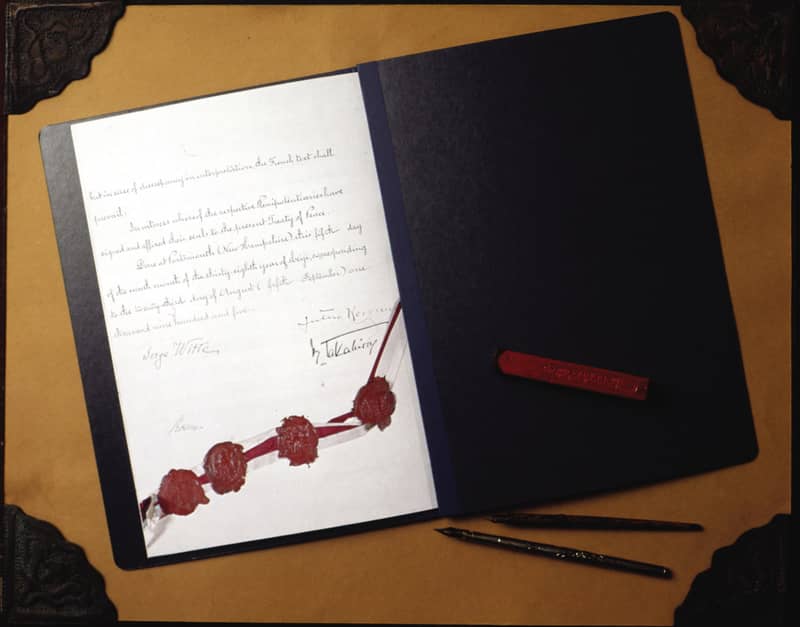
Lüshunkou (historically known in the West as Port Arthur) ceased to be under Japanese control at the end of the Second World War, in August 1945. Following Japan’s surrender, control of the port passed to the Soviet Union, which occupied the area. It was finally returned to the People’s Republic of China in 1955.
Sources consulted
Papers Past, the National Library of New Zealand’s online archive.
Heritage et al. Unique collections and resources held by research centres and heritage collections at the Auckland Libraries (New Zealand).
British Cartoon Archive. University of Kent.
Official website of the Russian Historical Society.
Boris Yeltsin Presidential Library
Kobayashi Kiyochika (1847–1915). Caricatures of the Russo-Japanese War.
Miguel de Cervantes Virtual Library.
Virtual Library of Historical Press
Official blog of the Lázaro Galdiano Museum.
Graphic History. Guille’s blog.
Website of the New Hampshire Japan-America Society on the Portsmouth Peace Treaty.
You might also be interested in:






#/media/File:Bear_art_detail,_Bob_Satterfield_cartoon_about_Uncle_Sam's_1903_Christmas_presents_(cropped).jpg?utm_source=jrmora.com)