No. No cartoon has ever ‘changed the world’, and I doubt any ever will. I’m sorry for the blunt spoiler, but since I used the sensationalist technique of slapping a question in the headline, I had to make amends as soon as possible.
According to Betteridge’s law of headlines,‘any headline in the form of a question can be answered with “ no”’. And this one is no exception. If the answer is known, there is no need for the question; and if it is unknown, even less so. Furthermore, in most cases (save for a few indisputable truths that do not require a question either), a resounding ‘no’ will fit perfectly.
According to its creator, Ian Betteridge, this saying became popular after he wrote a humorous, off-the-cuff blog post that turned into an ‘Internet law’ and which led to its author ‘becoming better known for something that was actually just a trivial comment’.
I was asked a variation of this question one day, and it has been put to more than one cartoonist, because there are people who continue to attribute supposed superpowers and an influence to cartoonists that they do not possess. Many of us are self-confessed amateurs, and fortunately I do not know of anyone so insultingly pretentious as to believe they possess such abilities.
Be that as it may, cartoons do not expose scandals or uncover crimes; they are opinions that draw on the work of the press or public opinion, so it is almost impossible for them to be the primary catalyst for global structural changes, although they may, like any other work, play an active part in the wider picture that leads to certain changes.
If only a cartoon could change the world, because a piece with that kind of power could be the universal crowning glory for any cartoonist. The holy grail of cartoons, something far beyond what we now call ‘going viral’. A timeless work – something that some artists manage to achieve to a certain extent with just a single song, book, painting or building, even without having changed anything. In contrast, cartoons are, by their very nature, ephemeral, save for very exceptional cases.
On this point, Quino was in no doubt. Whenever the discussion turned to whether comics and humour could raise social awareness and lead to significant change, he would often recount an anecdote in which he quoted the response of an American cartoonist.
"There are people who say that, well, humour can make people think, but that’s not true. Recently in Angoulême, where they hold a comic book fair ( the Angoulême International Comics Festival) , they were interviewing an American cartoonist*, who draws Captain America’s sons (referring to Captain America), and they asked him precisely this, and he said:
"We Allies didn’t drive Hitler out with Indian ink"(...) "I think that’s an excellent answer," said Quino in an interview on RTVE in 1976.
*I do not know which cartoonist he was referring to, as neither the name nor the date of those statements was given.
In a statement that has become an aphorism – one of the many he left us – Jaume Perich took a similar stance when he said:“Thanks to freedom of expression, it is now possible to say that a leader is useless without anything happening to us. Nor to the leader.”
Returning to this habit of elevating cartoonists to the pantheon of the great conscience-stirring figures, one can find works that juggle with this idea, albeit always with a catch. To give an example, there is a book with a title as appealing as it is misleading:*50 Cartoons That Changed the World* by Roberto Fandiño, published in 2016, which I read at the time. It is not a bad book, but it has a poor title because, to put it mildly, the title rather glosses over the content, as it merely compiles various historical events or passages and links them to specific cartoons or the body of work by different artists.
Even so, so as not to be left with just that categorical ‘no’ to the question in question, there is a case that does not appear in Fandiño’s book, which could well be one of those examples of vignettes that set off far-reaching events by playing an important role or acting as the main catalyst. (Although there’s a catch to it, too).
The power of cartoons: the case of Thomas Nast versus ‘Boss’ Tweed
In the 1860s and 1870s, the cartoonist Thomas Nast popularised the cartoon format in the American media through *Harper’s* magazine, becoming a staunch advocate of municipal reform. His main target was William M. ‘Boss’ Tweed, leader of Tammany Hall, the powerful Democratic Party political machine that controlled the New York City government, whom he accused of defrauding the city of millions through blatant corruption. Estimates of how much this man stole vary widely; it is said that he defrauded the city of between 20 and 200 million dollars of the time
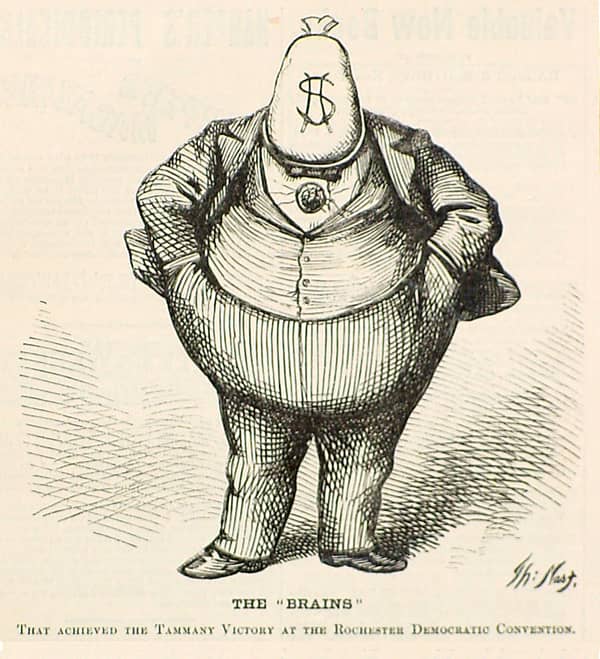
The great influence of Nast’s work lay in its visual impact. According to the stories of the time, most of the voters who supported Tweed were illiterate and could not read the critical articles in the press, but they understood the illustrations perfectly well. The threat posed by these publications was such to the corrupt politician that, according to legend, Tweed is said to have exclaimed: ‘Stop those damned cartoons!’
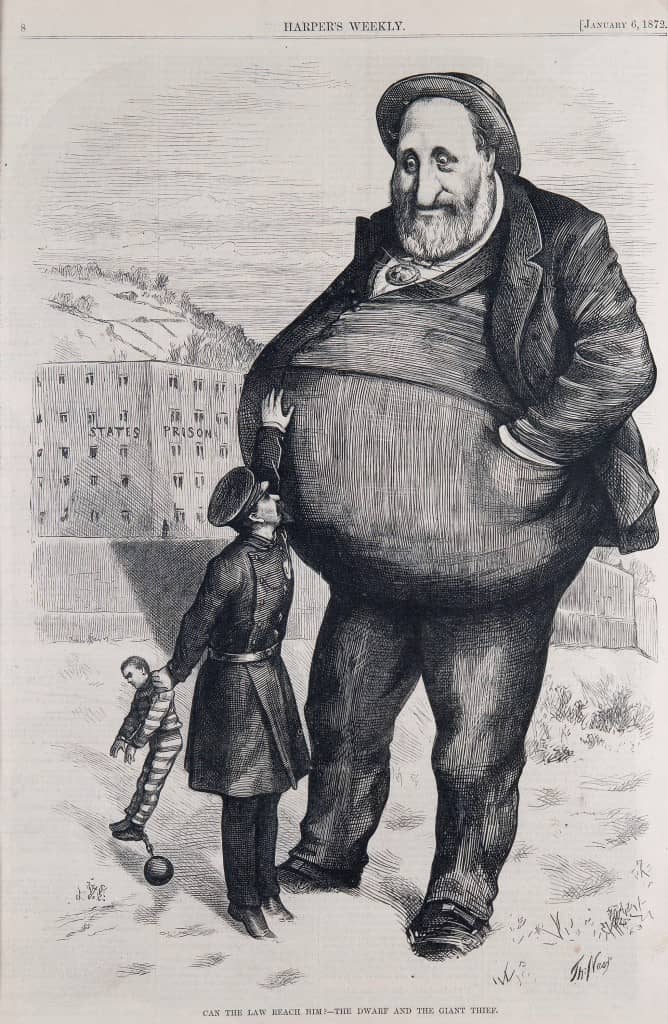
After failing in their attempt to bribe Nast with a substantial sum of money disguised as a scholarship to Europe, and after their threats to boycott Harper’s publisher proved ineffective, the cartoons continued to have a profound impact on public opinion. Although the images alone did not compel people to vote in a particular way, they did help to stir up public outrage: the 1871 elections weakened the Tweed Ring by ousting Tammany’s candidates from office.
The influence of the illustrations extended beyond the polling stations when, after being prosecuted, convicted and having fled to Spain in 1875, ‘Boss’ Tweed was finally recognised by a Spanish officer thanks to a caricature by Nast, which led to his extradition back to a New York prison, where he remained incarcerated until his death in 1878.
It should be borne in mind that it was not until 1880 that the first photographs began to appear in the American press.