The Maine, the big excuse
.
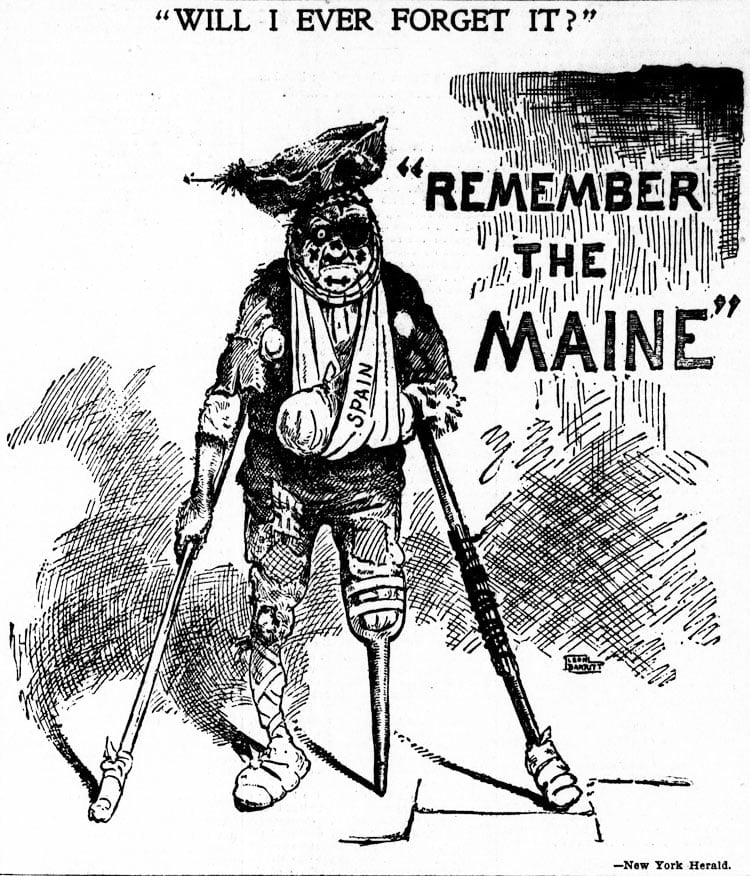
The Herald, May 15. "Remember the Maine". Despite not being able to prove Spain's involvement in the sinking of the Maine (which may have been due to an accident although others claimed it was sunk by the Americans), the press continued to repeat that it was the Spaniards.
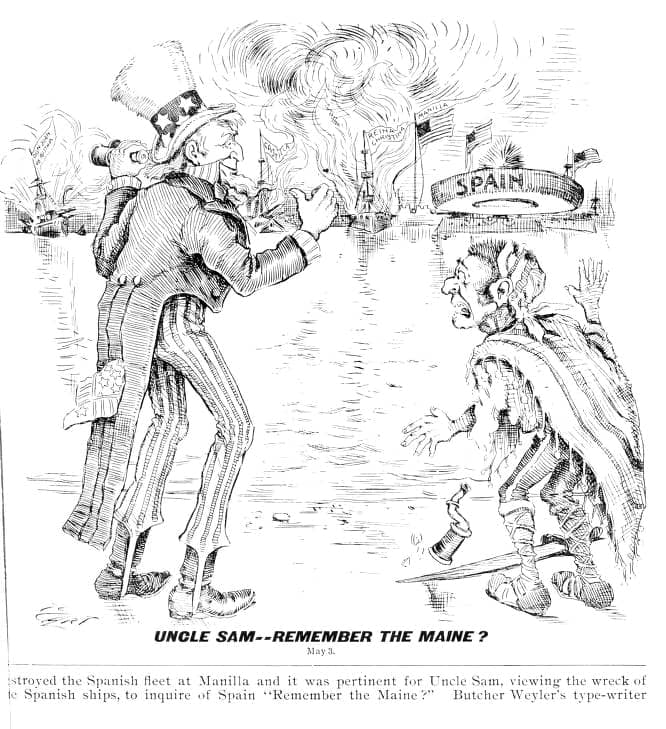
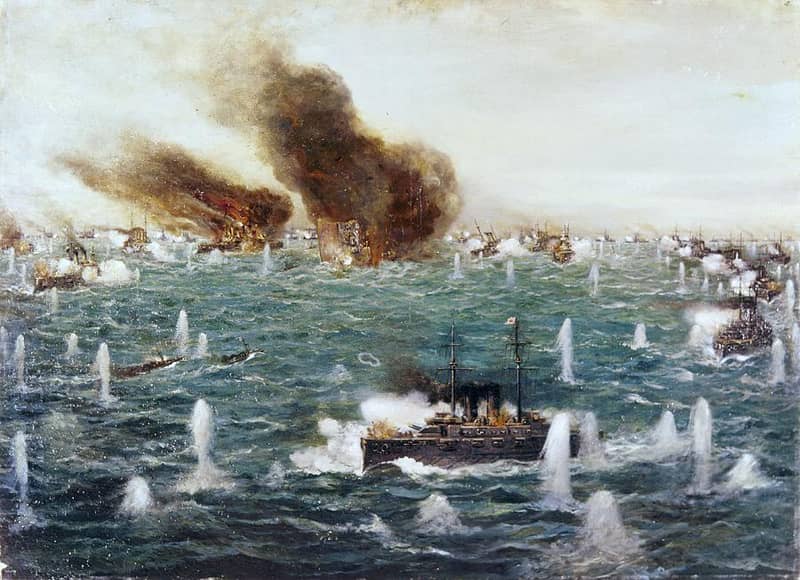
The Spanish fleet is destroyed in Manila, and Uncle Sam, seeing the wreckage of the Spanish ships, asks Spain, "Remember the Maine?"
Cartoon of May 3, 1898, published in "Cartoons of the Spanish-American War" book of cartoons by the cartoonist of the Minneapolis Journal Charles Lewis Bartholomew ,"Bart" (1869-1949).
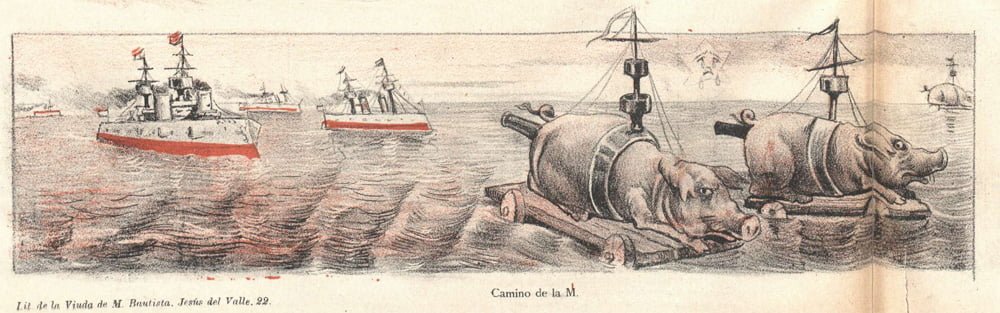
Legend: Way of the M. (It is understood that it refers... to shit?) from the spanish expressión "A la mierda"
Spanish ships expelling the Americans represented once again as pigs.
Illustration published in the magazine Don Quixote number 21 of Friday 27 May,

Cover of the magazine La Campana de Gràcia, number 1518 of 28 May.
Title: "Desperation of Spain". Caption: "To save the rights of Europe in America, I am giving my children, my blood and my treasures... And Europe is abandoning me!
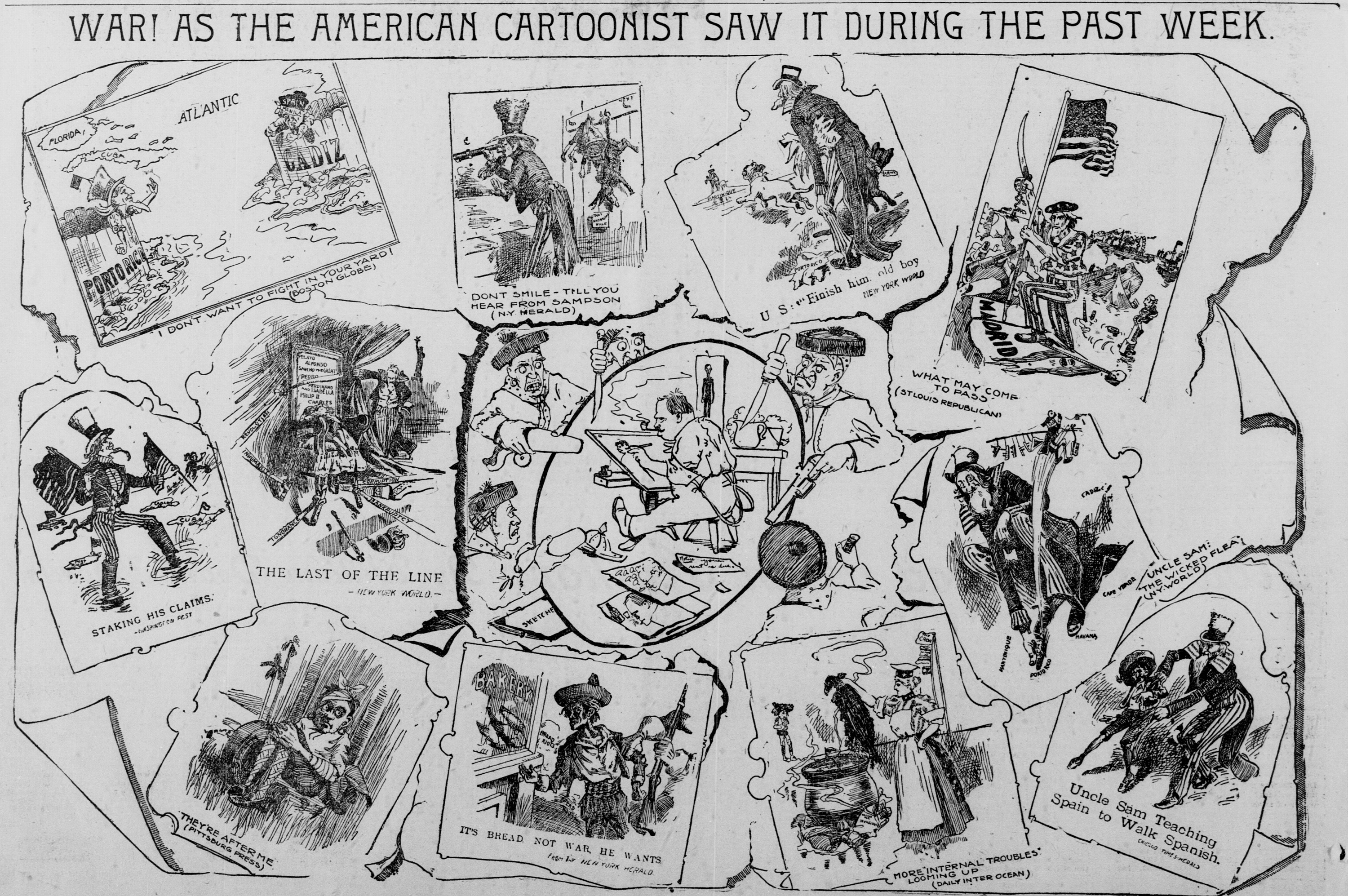
22 May, collection of cartoons from different American media published in The San Francisco Call.

Cartoon in The Herald, 3 June. President Sagasta surrenders with the king, dwarfed, crying, touched in his honour, the bank of Spain sinks to the bottom.
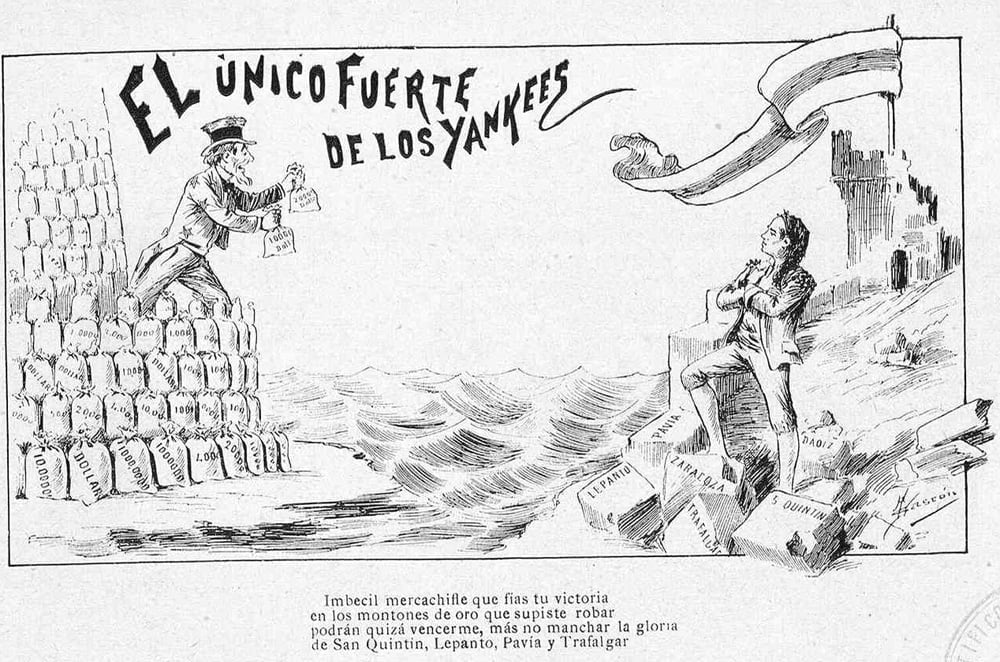
Madrid Cómico magazine number 799 of June 11. The cartoon extols Spain's historic victories and despise the Americans by pointing out that their only power is money.
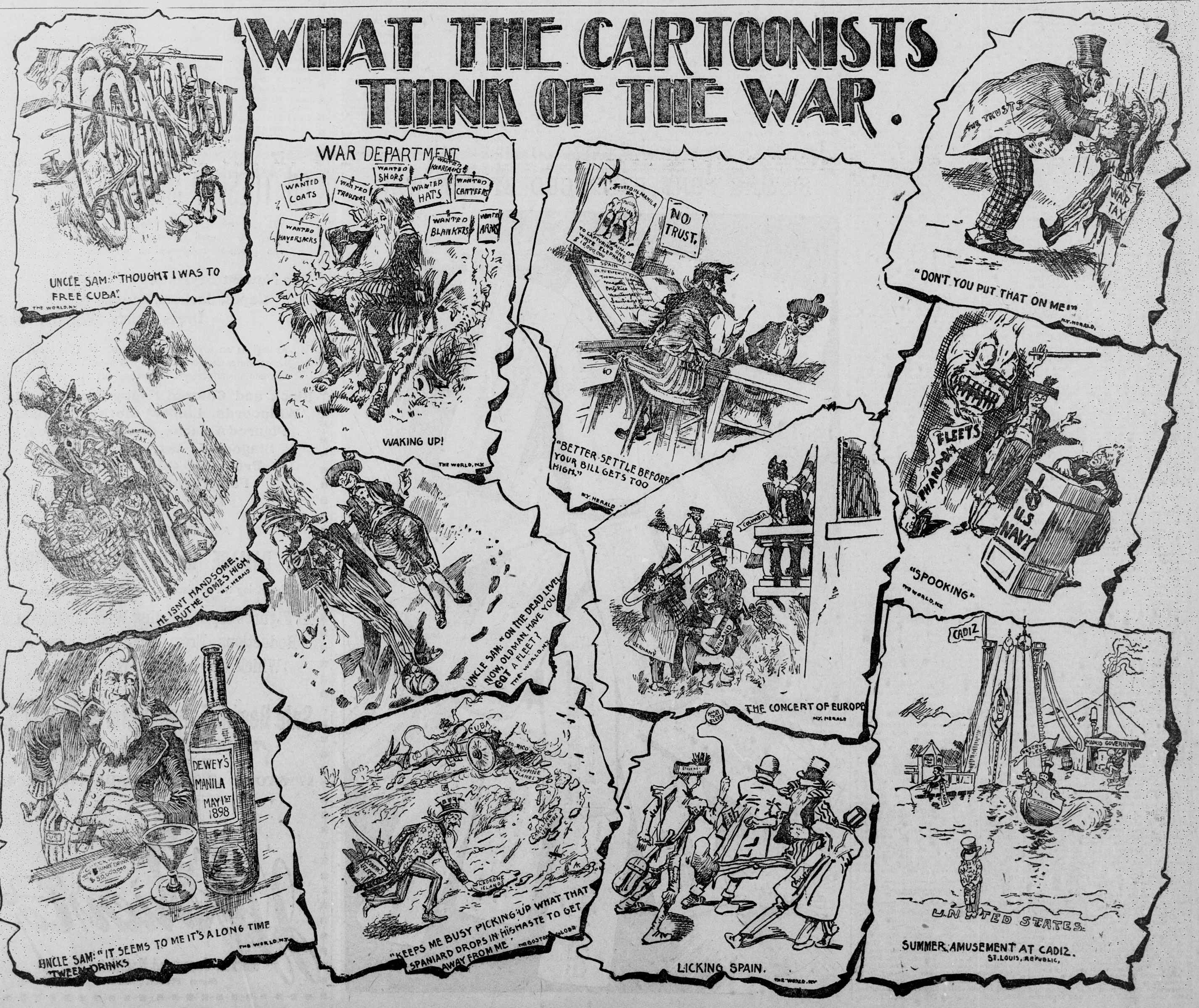
Compilation of cartoons published in The San Francisco Call, Sunday 3 July.
The Spanish "monster"
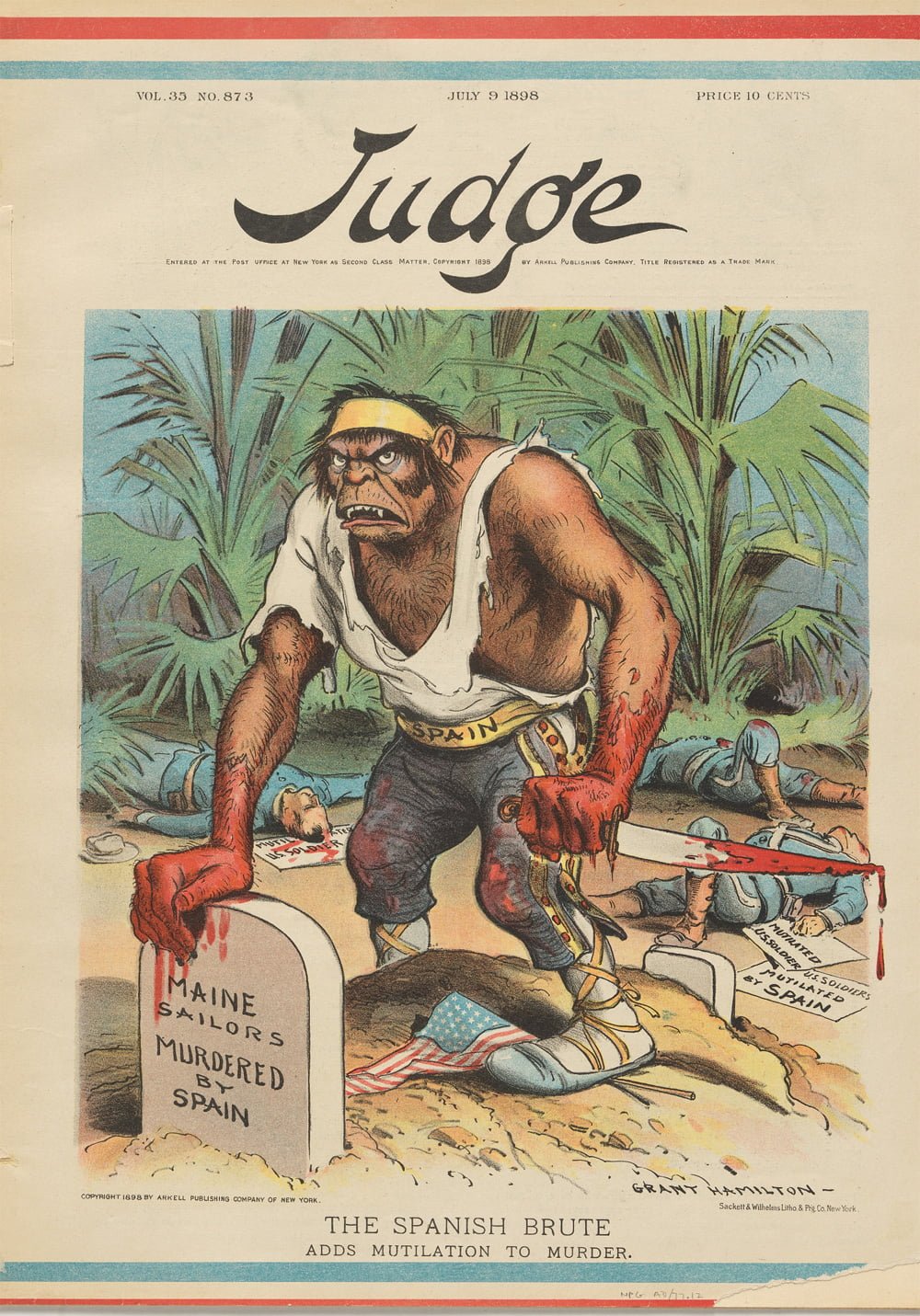
Judge magazine, although it was not a sensationalist publication, already at the beginning of the war published some images going with the flow, such as the cover illustrated by Grant Hamilton (1862 - 1926) on 9 July 1898 with the legend: "The Spanish brute adds mutilation to murder", related to the death of the sailors in the explosion of the Maine.

July 10th. Another "Barber" cartoon in The Herald with the caption "Will Spain let it fly? In the image a Spaniard throwing salt on the wings of the dove that represents peace.
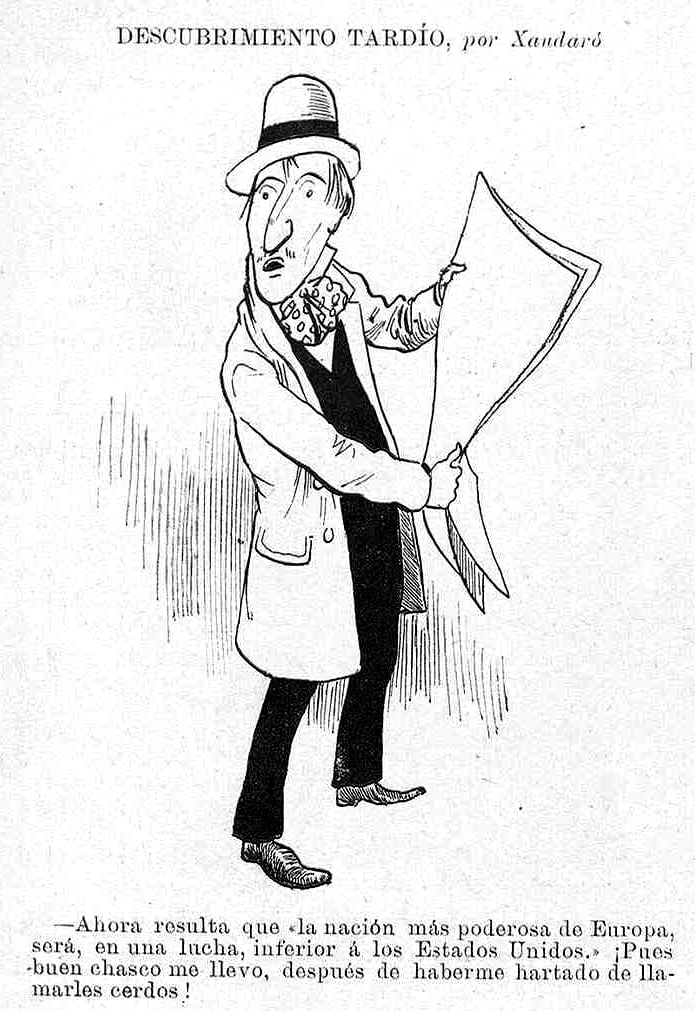
Cartoon by Joaquín Xaudaró from 23 July 1898 in the magazine Madrid Cómico.
Xaudaró draws on a mixture of self-criticism and irony and say:
"Now it turns out that the most powerful nation in Europe will, in a fight, be inferior to the United States, and I am disappointed, after having called them pigs so many times!"
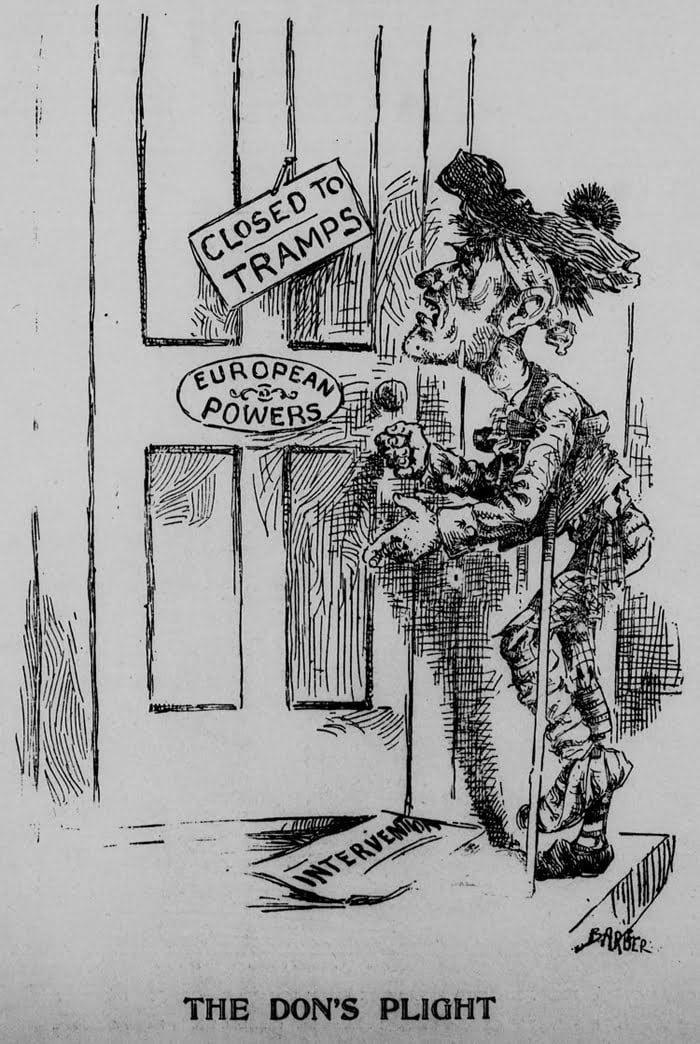
Again Barber in The Herald, August 2. A Spaniard knocks on Europe's door asking for intervention in the war. The sign reads: "Closed to cheaters" (or vagrants?)

4 August, unsigned cartoon in The Valentine Democrat.
Description. A figure representing Spain looks at a painting on the wall that reads: "your days are numbered and you will no longer make mankind miserable". In the book, on his knees, he cites the Inquisition, the sinking of the Maine, murders, tortures and other international "records of glorious spain".
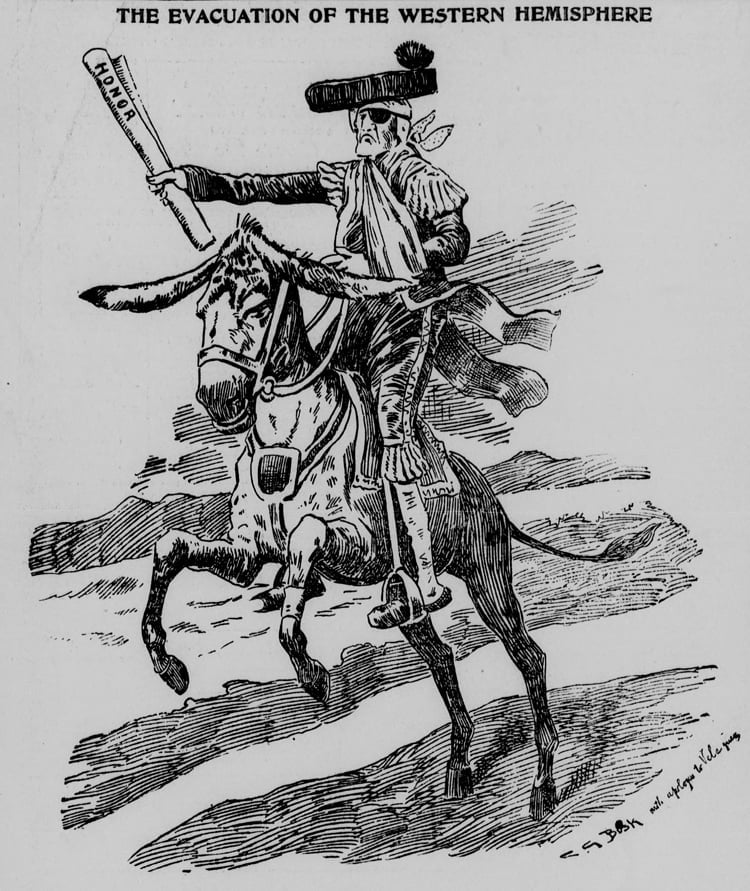
On 14 August, the war is over. The Herald publishes this cartoon entitled "The Evacuation of the Western Hemisphere" with a Spaniard retreating on a donkey, holding in his right hand a parchment with the legend "honour". The painting "Prince Balthasar Charles on horseback" by Velázquez is parodied. The author apologises to Velázquez along with his signature.

"The lesson is learned". In the scene, again Uncle Sam with the rule of war in his hand, forces the Spanish to learn the lesson of peace.
Cartoon of September 2nd published in The Kinsley Graphic and reproduced by many other media.
Sources consulted:
 Biblioteca Virtual dePrensa Histórica
Arca, arxiu de revistes catalanes antigues
Biblioteca del Congreso de Estados Unidos
Cartoons of the Spanish-American War. Charles Lewis Bartholomew, 1869-1949
Los periódicos de Madrid en 1898, Concha Edo, UCM (PDF)
1898: Prensa y opinión pública en España y los Estados Unidos, Juan Jiménez Mancha , UCM Revista SEECI
Prensa sensacionalista americana en el S.XIX y su contribución en la guerra hispano-estadounidense. Análisis de las portadas americanas de la época. Fernando Barahona. (PDF) (Spanish).
Summary: Key points of the "graphic war" of 1898
How did the press influence the outbreak of the war in 1898?
The Spanish-American War is considered the first conflict driven by media sensationalism. The US "yellow press", led by figures such as Hearst and Pulitzer, used cartoons and exaggerated news stories to demonise Spain and manipulate public opinion after the explosion of the Maine.
William Randolph Hearst: owner of the New York Journal. He was the more aggressive of the two. He is credited (although there is debate about the historical accuracy) with the famous phrase attributed to his illustrator Frederic Remington: "You provide the pictures, I'll provide the war" while Joseph Pulitzer, owner of the New York World, although today his name is associated with journalistic excellence (due to the Pulitzer Prizes), at that time competed fiercely with Hearst using the same sensationalist tactics.
What symbols were used to represent Spain and the United States in the cartoons?
In the Spanish press, the country usually portrayed itself as a fierce lion, while Americans were depicted as invading pigs or looters. In contrast, the US press used Uncle Sam as a symbol of justice and portrayed Spaniards as barbarians, bandits or bloodthirsty monsters.
What role did cartoons play in the sinking of the Maine?
Following the explosion of the battleship Maine in Havana, American cartoons played a key role in directly blaming Spain without any evidence. Cartoonists of the time drew Uncle Sam pointing at "treacherous Spaniards", popularising the famous battle cry: "Remember the Maine, to Hell with Spain!".
Are many Spanish cartoons from the Cuban War preserved?
Although there is extensive documentation in the American press, Spanish cartoons from 1898 are more difficult to find in newspapers, perhaps due to the crisis in the press at the time. However, satirical magazines such as La Campana de Gràcia and Madrid Cómico kept up the graphic momentum during the conflict.
How did the press of the time portray Cuba and the Philippines?
In the cartoons on both sides, the colonies were often depicted in a paternalistic or degrading manner: either as young, defenceless women who needed to be 'rescued' by the US, or as wild and ungrateful children, depending on the propaganda interests of the moment.